
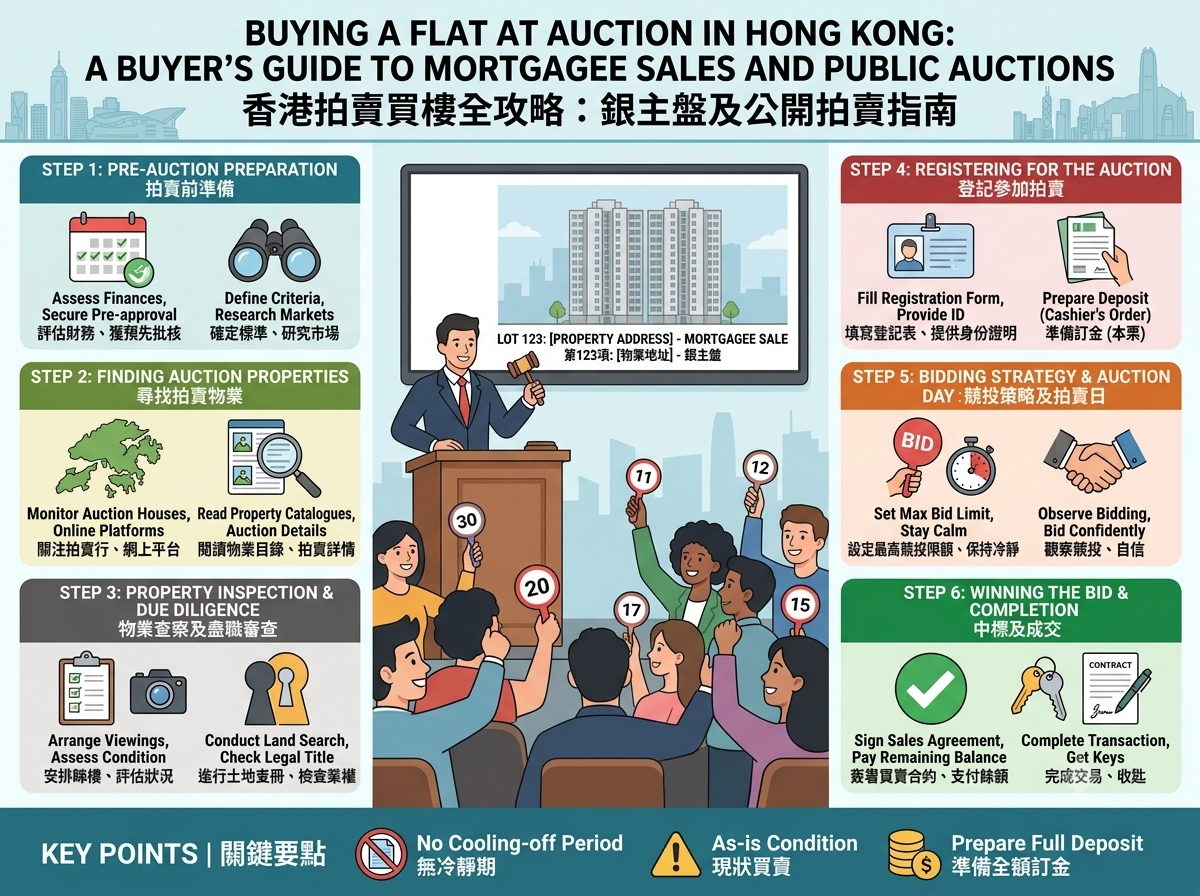
Every so often a Hong Kong listing appears with a label that makes buyers look twice: mortgagee sale, or 銀主盤. The asking price sits noticeably below what comparable flats in the same block have been fetching, and the description is unusually brief. For buyers who have spent months losing out on ordinary listings, an auction flat can look like the shortcut they have been waiting for.
It sometimes is. But an auction purchase in Hong Kong runs on a different set of rules to a normal transaction, and almost all of those rules are written in the seller’s favour. The discount you see is not a market inefficiency — it is the price of the risk being handed to you. This guide explains where auction flats come from, what protections you give up when you buy one, and the checks that separate a genuine opportunity from an expensive lesson.
Why Hong Kong Flats End Up at Auction
The best known route is the mortgagee sale. When a borrower defaults, the lender can exercise its power of sale under the mortgage and dispose of the flat to recover what it is owed. Banks and finance companies generally prefer a transparent, defensible process, which is why so many of these properties go to public auction rather than a quiet private sale.
Auctions also arise from disputes and legal process. Co-owners who cannot agree on what to do with a jointly held flat may end up with a court-ordered sale, and matrimonial proceedings can produce the same outcome. Executors administering an estate sometimes choose auction precisely because it demonstrates that the best available price was obtained. Receivers and liquidators appointed over a company will often auction property assets for the same reason. Separately, sites assembled for redevelopment under the Land (Compulsory Sale for Redevelopment) Ordinance are sold by court-ordered auction, though those are usually whole buildings rather than single flats.
It is worth noting that Hong Kong government land sales are also conducted by tender or auction, but that is an entirely different arena aimed at developers. The auctions relevant to ordinary buyers are the residential, commercial and car-park lots offered by auction houses and the larger agencies, typically in scheduled sessions with a published catalogue.
What “Sold As Is” Really Means
Nearly every auction lot in Hong Kong is offered on an as-is basis, and that phrase carries far more weight than it appears to. The seller makes no promises about the physical state of the flat, the accuracy of any stated area, the presence of unauthorised building works, or whether the fittings shown in a photograph will still be there on completion.
A mortgagee is in an awkward position here: it never lived in the flat, may never have been inside it, and cannot honestly warrant much at all. So the conditions of sale are drafted to strip out the protections a buyer would normally expect. The title guarantee is usually limited. Requisitions on title — the queries your solicitor would ordinarily raise and expect answers to — are often restricted or excluded entirely. Any special conditions attached to a particular lot override the general conditions, and they are where the genuinely important carve-outs tend to hide.
Most significantly, you may be buying without vacant possession. If a former owner or a tenant is still in occupation, removing them becomes your problem, your legal cost and your delay. Some lots state this plainly; others are silent, which is itself a warning.
Due Diligence Before the Hammer Falls
All the investigation that a normal purchase spreads over several weeks has to happen before you bid, because after the hammer falls there is nothing left to negotiate.
Start by obtaining the auction particulars and the conditions of sale as early as they are available, and put them in front of a solicitor who has handled auction work. This is not a document to skim. Ask specifically about the extent of the title guarantee, any restriction on requisitions, the completion period, and who bears outstanding charges.
Run a land search at the Land Registry against the property. It will show the registered owner, the mortgages and charges, and any encumbrances, court orders or memorials that have been registered. Read the Deed of Mutual Covenant and, where you can, ask the management office about arrears of management fees and any special levy for building works. Sums attached to a unit can end up as a practical liability for the incoming owner, and a long-neglected flat is exactly the kind that accumulates them.
Check with the Buildings Department for outstanding orders, notices or registered unauthorised building works. A flat carrying a live removal order is a very different proposition to one that does not, and the cost of compliance falls on whoever owns it when the deadline arrives.
Where the sale arises from an estate or a court order, confirm that the seller actually has authority to sell — a grant of probate or letters of administration, or the relevant court order — and that it covers the property being offered. Your solicitor should see the document rather than take the catalogue’s word for it.
Viewing is often the hardest part. Access may be limited to a single scheduled slot, restricted to the common areas, or unavailable altogether if the flat is occupied. If you cannot get inside, assume the worst reasonable case: full replacement of kitchen, bathrooms, wiring and windows, plus the cost of clearing whatever has been left behind. If access is granted, bringing a surveyor or an experienced contractor is money well spent.
Deposits, Deadlines and Mortgage Risk
The financial mechanics are where inexperienced bidders get caught. A deposit is payable immediately on the fall of the hammer, commonly by cashier’s order, and you sign the memorandum of sale on the spot. There is no cooling-off period and no walk-away arrangement of the kind built into an ordinary provisional agreement. If you fail to complete, you can expect to forfeit the deposit and remain exposed to the seller’s further losses.
Critically, an auction contract is not conditional on you obtaining a mortgage. The completion date is fixed by the conditions of sale and is frequently shorter than the timeline a normal purchase allows. Your financing has to fit that window regardless of how the bank behaves.
That makes valuation the single largest hazard. Banks lend against their own valuation, not your winning bid, and they apply extra caution to flats with occupation issues, unauthorised works, very small sizes, unusual layouts, or older buildings without lifts. Speak to more than one lender before the auction, discuss the specific property and its address, and understand what they will and will not lend on. A generic pre-approval in principle is not the same as an indication on this flat.
Budget beyond the bid, too. Stamp duty applies to auction purchases in the ordinary way, and there is normally an auctioneer’s commission on top of the hammer price. Add legal fees, which are usually higher for auction work, plus renovation, and a contingency for possession proceedings if occupation is unresolved. A flat that looked comfortably cheap can close that gap quickly.
On Auction Day: Mechanics and Discipline
Registration comes first: identification, and the deposit instrument in the form the auctioneer specifies. Ask in advance whether bidding by proxy or by telephone is permitted if you cannot attend, and what written authority the auctioneer needs from you.
Lots carry a reserve, which is not usually disclosed. If bidding does not reach it, the lot is withdrawn — and this is where opportunities sometimes appear, because unsold lots are frequently available by private treaty afterwards, occasionally on more negotiable terms. Bidding proceeds in set increments, and once the hammer falls the contract is formed. There is no reflection period.
The discipline that matters most is deciding your ceiling in advance and writing it down. Work backwards from what you can borrow, what renovation will cost, and what comparable flats in the same estate have actually transacted at — then subtract a margin for the protections you are giving up. Attending one or two auctions purely to watch, without registering to bid, is one of the cheapest forms of education available to a Hong Kong buyer.
Auction flats suit a particular profile: buyers with cash depth, tolerance for uncertainty, the appetite to renovate, and the patience to deal with a possession problem if one arises. They suit first-time buyers stretched to the limit of their borrowing capacity far less well.
The Takeaway
An auction discount in Hong Kong is compensation for risk transferred from the seller to you — risk on title, condition, occupation and financing. If you have run the searches, read the conditions of sale with a solicitor, confirmed what a lender will actually advance on that specific flat, and set a ceiling you will not cross, an auction can be an efficient way to buy. If any one of those is missing, the ordinary purchase is the safer one.