
Most owners of older Hong Kong flats assume nobody can sell their home without their signature. That is broadly right, with one significant statutory exception. Under the Land (Compulsory Sale for Redevelopment) Ordinance (Cap. 545), a party that has bought up enough of the undivided shares in a lot can apply to the Lands Tribunal for an order that the whole lot be sold for redevelopment — and the owners who never agreed to sell are carried along with it.
That exception became considerably wider on 6 December 2024, when the Land (Compulsory Sale for Redevelopment) (Amendment) Ordinance 2024 came into operation. Passed on 18 July 2024, it lowered the ownership thresholds, allowed a single application to span several adjoining lots, and created a fast track through the Tribunal. For anyone who owns, lets out or is considering buying in a building approaching fifty years old, compulsory sale has moved from a remote curiosity to a mechanism worth understanding.
What a compulsory sale is — and what it is not
Three mechanisms get muddled in conversation. Land resumption is the Government taking private land for a public purpose and paying statutory compensation. An Urban Renewal Authority project begins with the URA announcing a scheme and making acquisition offers, with resumption available if acquisition is not completed. Compulsory sale under Cap. 545 is neither: it is entirely private. A majority owner assembles undivided shares on the open market, flat by flat, then asks the Tribunal to order a sale of the whole site.
The distinction that matters most: an order does not transfer your flat to the applicant. It directs that the lot be sold as a whole — normally by public auction — and that the proceeds be apportioned among every owner. The sale is run by trustees appointed by the Tribunal, and any person may bid, including a minority owner. In practice the applicant is usually the only serious bidder, because it already holds most of the site.
The thresholds after the 2024 reform
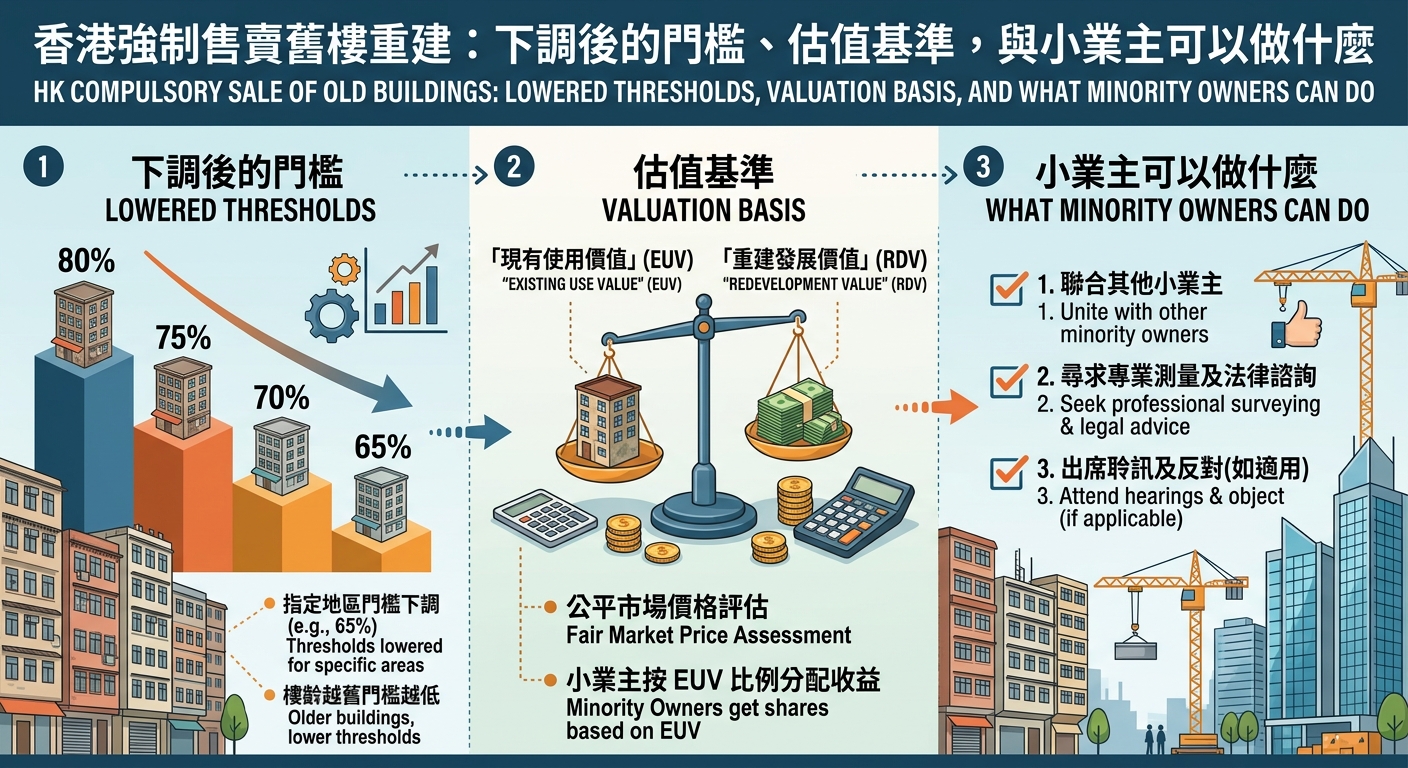
The starting point in Cap. 545 has always been 90 per cent of the undivided shares in the lot. From 1 April 2010 a lower 80 per cent threshold applied to specified classes — principally buildings aged 50 or above, and industrial buildings aged 30 or above. The 2024 reform kept that architecture but cut the numbers again, and added a geographical dimension: seven “designated areas” where the threshold is lower than for a building of the same age elsewhere.
| Existing development on the lot | In a designated area | Elsewhere |
|---|---|---|
| Aged 50 to 59 years | 70% | 80% |
| Aged 60 to 69 years | 65% | 70% |
| Aged 70 years or above | 65% | 65% |
| Industrial, aged 30 years or above, in a non-industrial zone | 70% | 70% |
| Not within a specified class | 90% | 90% |
The floor is now 65 per cent. In plain terms, a party holding roughly two thirds of a seventy-year-old block can start the process, where four years ago it needed four fifths. That changes the arithmetic of site assembly, and it changes the bargaining position of the last few owners — because the applicant no longer needs them to reach the threshold.
The seven designated areas
The designated areas are Cheung Sha Wan, Ma Tau Kok, Mong Kok, Sai Ying Pun and Sheung Wan, Tsuen Wan, Wan Chai, and Yau Ma Tei. They were selected by reference to the number of buildings aged 50 or above in the area and the number issued with notices under the Mandatory Building Inspection Scheme, and the list is reviewed periodically — so it is a policy instrument rather than a fixed feature of the law.
Two of the seven sit squarely inside prime Hong Kong Island: Sai Ying Pun and Sheung Wan form one designated area, and Wan Chai is another. These are places where early post-war walk-ups stand a street away from towers completed in the past decade. If you own in the older half of that mix, the threshold for your building is now lower than for an identical building in, say, Tai Hang or Kennedy Town.
A note on the numbers
Registered transaction records give some sense of scale. Read on 8 September 2026, publicly available transaction data for the trailing three years shows 211,769 sale records and 82,122 letting records across Hong Kong — 293,891 in total — of which 21.86 per cent involved buildings aged 40 years or above. For Sai Ying Pun alone the same source shows 1,834 sale records and 1,097 letting records over the same period, with the share involving buildings aged 40 years or above rising to 30.89 per cent. The district’s largest single band is 5 to 15 years, at 34.09 per cent, which captures its split personality neatly.
Two caveats. The published band is “40 years or above”, not the 50-year statutory trigger, so it overstates the cohort within reach of the lower thresholds; and these are counts of transaction records rather than buildings. The figures are individual registered transactions, not market averages.
How an application actually runs
The application. The majority owner files a valuation report, prepared not earlier than three months before the application date, assessing the market value of every property on the lot on three assumptions: vacant possession; ignoring the possibility of a compulsory sale order; and ignoring the redevelopment potential of the property or the lot. Hold on to that third assumption. The applicant must then serve the application on each minority owner, register it against the lot, affix a bilingual notice on a conspicuous part of the building, and publish notices in at least one Chinese-language and one English-language newspaper.
Determination. If a minority owner disputes an assessed value, the Tribunal must hear and determine that dispute and may adjust the valuation. The applicant must separately satisfy the Tribunal that redevelopment is justified by the age or state of repair of the existing development, and that it has taken reasonable steps to acquire all the undivided shares, including negotiating on fair and reasonable terms with any minority owner whose whereabouts are known. Where an owner cannot be traced, the applicant must show the assessed value of that owner’s property is not less than fair and reasonable.
The sale. If an order is granted, the Tribunal appoints trustees. The lot must go to public auction unless every party agrees in writing to another method the Tribunal approves, and at auction it goes to the highest bidder subject to a reserve price approved by the Tribunal — a reserve price that does take redevelopment potential into account. The sale must complete within three months of the order; a further three months can be granted on application, after which an unsold order becomes void.
Apportionment. Proceeds and associated expenses are apportioned among all owners pro rata, according to the values in the valuation report as adjusted by the Tribunal. The trustees distribute after deducting the expenses of sale and the legal costs of assignment, discharging liabilities due to the Government and encumbrances on the lot, and paying any tenant compensation the Tribunal has ordered.
Why the valuation report matters more than the auction
Put the two valuation rules side by side. Each owner’s share of the proceeds is fixed by a report that ignores redevelopment potential; the reserve price at auction includes it. Minority owners are not cut out of the uplift — the pot is apportioned pro rata, and a lot sold at redevelopment value produces a bigger pot for everyone. The point is subtler: the relative share each owner receives is set entirely by a document the applicant commissioned, on an existing-use basis, before any sale took place.
That makes disputing the valuation the principal lever a minority owner holds: a flat valued 5 per cent low relative to the rest of the building loses 5 per cent of its share of whatever the site fetches. The vacant-possession assumption cuts both ways — a flat let below market is valued as though empty, which usually helps the owner, while poor internal condition is not rescued by the site’s development value. It is also why the negotiation before an application is filed is the more consequential one: a private sale can be priced at whatever the parties agree, including a premium for being the last holdout, whereas once an order is made the pro rata formula governs.
The fast track, and what a Notice of No Objection gives up
The reform also attacked delay. Figures cited during the legislative process put the average processing time for compulsory sale cases between 1999 and October 2023 at 564 days. The fast track lets the Tribunal dispense with the enquiry into whether redevelopment is justified on grounds of age or state of repair, where the building is at least 50 years old and every minority owner has filed a Notice of No Objection. Where the Government holds undivided shares as bona vacantia, it is deemed to have filed one.
The trade-off deserves stating plainly. Filing a Notice of No Objection removes one ground of resistance, but it does not waive a dispute about value, which the Tribunal must still hear and determine. An owner who accepts that a seventy-year-old block will be redeveloped, yet disagrees about what their flat is worth relative to the others, is not obliged to fight both battles.
Two further changes matter. Applications can now cover several lots that merely adjoin one another, not only lots joined by a common staircase, with ownership averaged across a cluster of lots bound by a continuous boundary and further lots able to join where they fall within a specified class and the applicant holds at least 65 per cent. And an owner-occupier may remain in occupation for up to six months after the sale, provided rent is paid to the purchaser. On the support side, a dedicated office under the Development Bureau and a support service centre set up as a wholly owned subsidiary of the Urban Renewal Authority have both operated since 27 August 2024, offering minority owners legal advice, independent valuation, mediation, counselling and help finding a replacement flat.
What owners and buyers of older flats should check
Age and address. Use the occupation permit date, not the marketing year, then check whether the address falls inside one of the seven designated areas — that single fact can move the threshold from 80 to 70 per cent.
The land register. An application must be registered against the lot, so a land search will reveal one. More usefully, searching the whole building shows the pattern of assignments: units drifting into one holder, or into several corporate names, is what site assembly looks like from outside.
Undivided shares, not flat counts. The threshold is measured in undivided shares as allocated in the Deed of Mutual Covenant. Ground-floor shops and large low-floor flats often carry disproportionate shares, so a party holding few units can be closer to the threshold than it looks.
Inspection and repair history. Mandatory Building Inspection Scheme notices, unfinished common-area works and a thin sinking fund point the same way: a stronger redevelopment candidate, and a heavier repair bill meanwhile.
Your time horizon. Buying into an old block hoping for a buyout is a long-dated option, not a trade. Cases run for years, proceeds are divided on existing-use values, costs come off the top, and an order that produces no sale within six months simply lapses — so the flat has to stand up as somewhere to live or let regardless.
The takeaway
Compulsory sale is no longer a fringe provision. The threshold can now be as low as 65 per cent, seven designated areas — two of them in prime Hong Kong Island districts — carry lower thresholds than the rest of the territory, and a fast track exists for buildings over fifty years old where nobody objects. For owners, the document that decides how much they receive is a valuation prepared on an existing-use basis by the other side, which makes early independent valuation advice the highest-value spend in the process. For buyers, building age and the ownership pattern in the land register belong in the same due diligence pass as the Deed of Mutual Covenant.
This article is general information about a statutory process in Hong Kong and is not legal advice; owners facing or contemplating an application should take their own professional advice. Transaction figures were read from publicly available registered transaction records on 8 September 2026 and cover the trailing three years; they are records of individual transactions rather than market averages.