
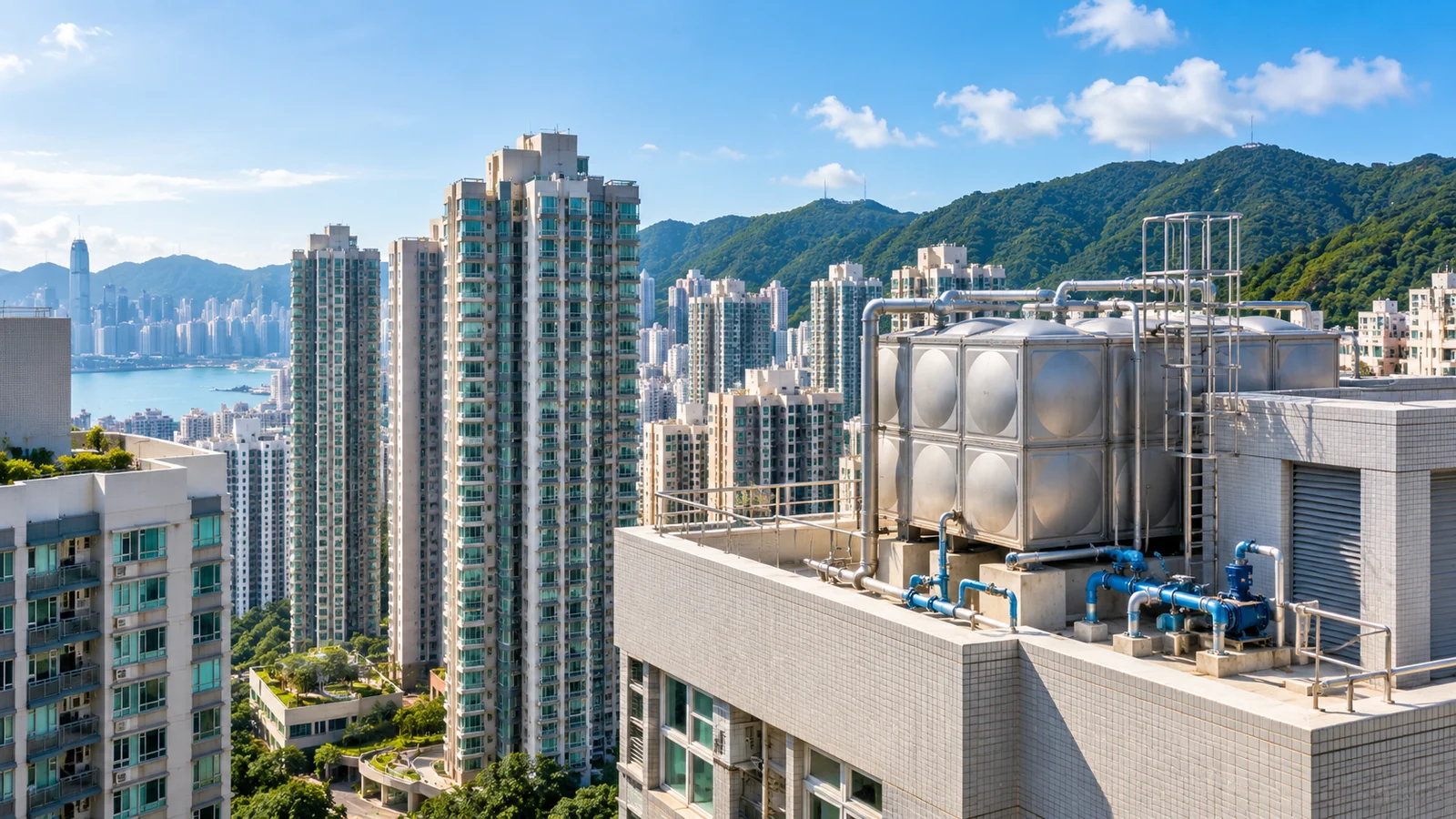
Turn on a tap in a Hong Kong apartment and water usually flows without a second thought. Yet in a residential tower dozens of storeys tall, how does water travel from the street to a kitchen or bathroom high above ground? And why might water pressure differ between floors of the same building?
The answer lies in an often overlooked part of building infrastructure: water storage tanks, pumps, distribution pipes and supply arrangements designed for different building heights. Understanding the fundamentals helps residents make sense of maintenance notices, temporary interruptions and the systems that support everyday living.
1. Can Public Water-Main Pressure Reach Every Floor?
Hong Kong’s public fresh-water distribution network maintains pressure so that water can travel through street mains and into buildings. According to the Water Supplies Department (WSD), its fresh-water pressure performance pledge is 15 to 30 metres of head. Under suitable conditions, mains pressure can generally supply a building of roughly six to seven storeys directly.
This is the principle of direct supply: water reaches premises using pressure already available in the public mains. But many Hong Kong residential buildings are far taller than this, so public mains pressure alone is insufficient for their upper floors.
Why not simply raise the pressure throughout the system? Excessive pressure could put lower-level pipes and fittings under greater strain, increasing the risk of leaks or damage. High-rise buildings therefore require more carefully designed internal distribution arrangements.
2. From Street Main to Apartment: The Water’s Journey
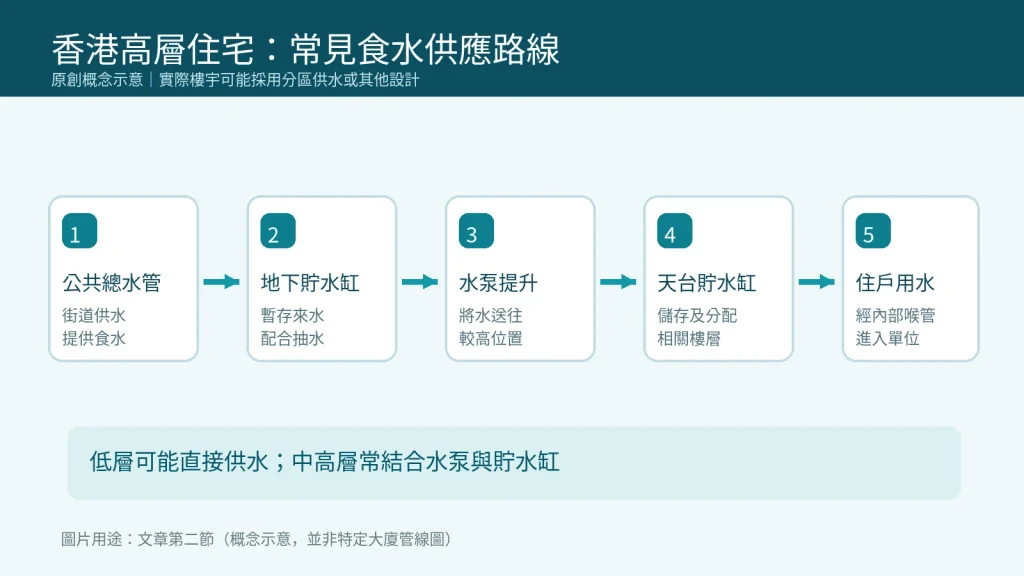
A common indirect-supply arrangement in a residential tower can be understood in five stages:
- Public water main: Fresh water enters the building from the public distribution network.
- Ground-level or lower-level storage tank: Some systems temporarily store the incoming water before pumping it upwards.
- Water pump: Mechanical pumping equipment lifts water to a higher level.
- Roof or intermediate storage tank: Water is stored and distributed through the building’s internal pipework to the relevant floors.
- Apartment outlets: Branch pipes supply kitchens, bathrooms and other points of use.
This is a simplified illustration, not the precise plumbing layout of every Hong Kong building. Some developments combine direct and indirect supply; others use pressure zones, intermediate tanks, booster systems and additional controls.
A tall residential tower is not served by a single uninterrupted pipe that simply runs from street level to the roof.
3. Why Does Water Pressure Vary Between Floors?
Water pressure is closely linked to height. When water travels downwards from an elevated storage tank, gravity produces greater pressure at lower points. Conversely, pushing water upwards requires enough pressure to overcome the vertical distance.
A high-rise building must balance an adequate supply to its upper floors with protection against excessive pressure lower down. Common design approaches include separating floors into pressure zones and using boosting or pressure-reduction equipment where necessary.
For example, some lower floors may receive fresh water directly from the public mains, while middle and upper floors are supplied through pumps and roof tanks. The actual configuration depends on building height, age and engineering design. Floor number alone therefore does not reliably predict the pressure at a particular tap.
4. Are Drinking Water, Flushing Water and Fire-Service Water Connected?
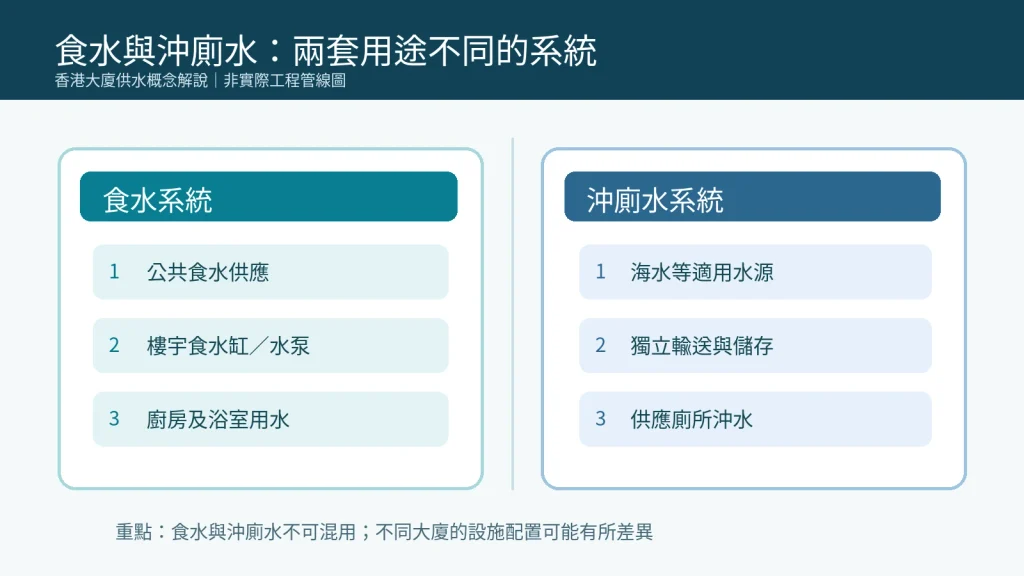
Hong Kong buildings generally distinguish among systems for fresh water, toilet flushing and firefighting, each serving a different purpose.
The fresh-water system supplies water for drinking, cooking, washing and other domestic needs. The flushing-water system supplies toilets. Much of Hong Kong uses treated seawater for flushing, while other suitable sources may be used in areas without seawater flushing. Flushing water must be kept separate from potable water.
Fire-service water systems support firefighting functions rather than ordinary household taps. Their arrangements depend on the building design and applicable requirements; not every building has identical equipment.
This separation also explains why a building may announce interruptions to fresh water and flushing water independently.
5. Are Roof Tanks Just for Storage?
A water tank does more than hold a volume of water. In a common indirect-supply system, a lower-level tank can support pumping operations, while an elevated tank stores and distributes water. This arrangement means that every tap does not necessarily depend on a pump pushing water directly to it at the moment of use.
Tank capacity and maintenance are both important. A tank that is too small may require more frequent pump operation; an unnecessarily large tank can increase the time water remains in storage and add structural load. Tank cleanliness, pipework condition and routine servicing all affect the reliability and hygiene of the building’s internal supply.
Water tanks are therefore a continuing building-management responsibility, not a one-off installation.
6. What Might Cause Weak Pressure or a Temporary Interruption?
A sudden reduction in flow or a temporary loss of water does not always mean that the public water supply has failed. Possible causes also include building pumps, tanks, valves, scheduled works, power interruptions or plumbing within an individual apartment.
Residents can begin by checking notices from building management. If neighbours on the same or other floors experience similar problems, reporting the affected areas can help management investigate. Where the issue may concern the public supply, WSD announcements can provide additional context.
Residents should not enter pump rooms, open communal water tanks or operate shared water-supply equipment themselves. Assessment and repairs should be handled through building management and appropriately qualified personnel.
7. What Maintenance Information Should Residents Look For?
Regular inspection and cleaning of internal plumbing systems are relevant to everyday living. WSD recommends that fresh-water storage tanks in buildings generally be cleaned and disinfected at least once every three months, or more often where necessary.
Residents do not need to be plumbing engineers to ask practical questions:
- Does the building announce water-tank cleaning and maintenance schedules?
- Do planned interruption notices explain the affected areas and expected timing?
- Is there a clear way to report recurring pressure or water-quality concerns?
- Are shared water-supply facilities maintained by suitable qualified personnel?
These questions are not a scorecard for ranking developments. They simply help residents understand one of the less visible aspects of building management.
Conclusion: Reliable Water Depends on More Than the Tap
Between the public main and a tap on an upper floor, water may pass through tanks, pumps, distribution zones and multiple sections of pipework. The building’s height, pressure management and separation of potable and flushing systems all require appropriate design and upkeep.
For residents, learning these principles can make it easier to understand maintenance notices and communicate with management when interruptions or weak pressure occur.
Living quality depends not only on what is inside an apartment, but also on the infrastructure serving the whole building.
Coming Soon: PropMark’s Owner Listing Service
PropMark will soon introduce an owner listing service that allows owners to market properties for sale or rent themselves, or select estate agents to assist with promotion. The upcoming service plans to provide complimentary professional property photography, advertisement creation, publishing and management support.
Learn more: PropMark Hong Kong