
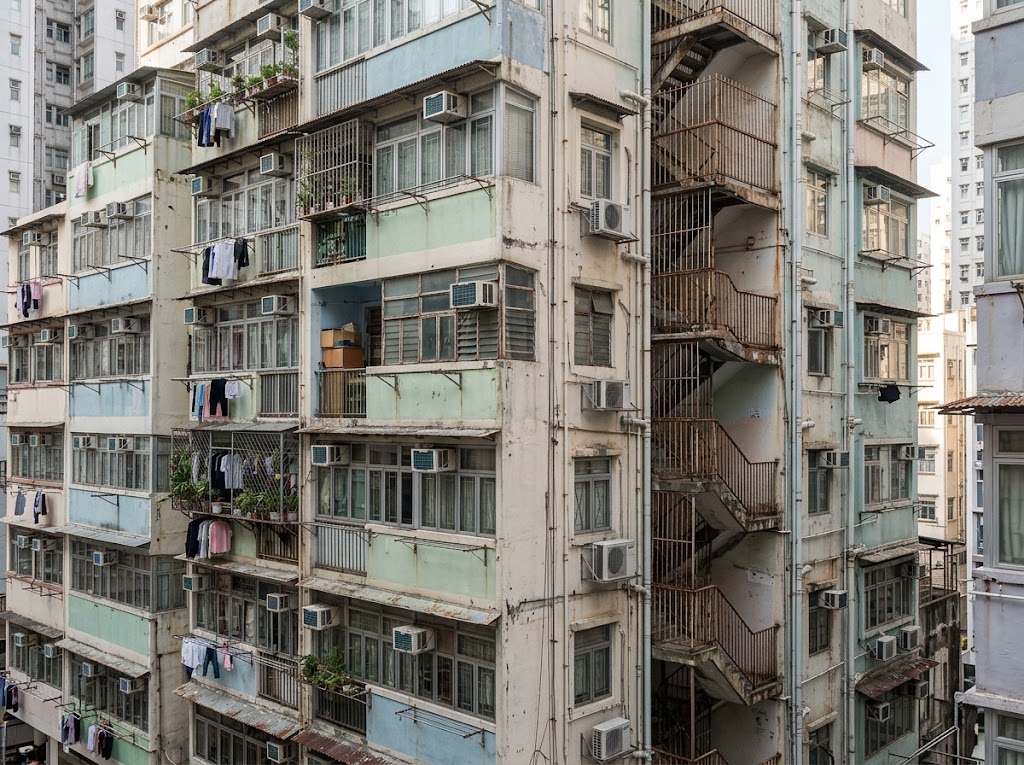
In Hong Kong’s established urban districts—such as Sheung Wan, Wan Chai, Sai Ying Pun, North Point, and Yau Tsim Mong—older private residential and composite (commercial/residential) buildings offer generous ceiling heights, high efficiency ratios, and superb transport links. However, properties built before the late 1980s carry a specific, frequently overlooked statutory burden governed by the Fire Safety (Buildings) Ordinance (Cap. 572).
Jointly enforced by the Fire Services Department (FSD) and the Buildings Department (BD), Cap. 572 mandates that pre-1987 buildings undergo comprehensive fire safety retrofitting. When building owners fail to comply within statutory timelines, authorities register the directive against the property at the Land Registry, creating a formal legal encumbrance (colloquially known as “fire safety order encumbrance” or 消防釘契). This guide examines the statutory mechanics of Cap. 572, the capital costs involved, conveyancing liability rules, and bank mortgage underwriting realities.
1. Scope and Target: Which Buildings Are Regulated Under Cap. 572?
The Fire Safety (Buildings) Ordinance applies specifically to target buildings constructed or whose building plans were first submitted to the Building Authority on or before 1 March 1987. The legislation divides target properties into two distinct categories:
- Composite Buildings (綜合用途建築物): Multi-storey blocks combining commercial use (ground floor retail, upper-floor offices or clinics) with domestic apartments;
- Domestic Buildings (住用建築物): Exclusively residential buildings exceeding three storeys in height.
Under Section 5(1) and Section 6(1) of the Ordinance, the enforcement authorities issue statutory Fire Safety Directions (消防安全指示) addressed either to the Incorporated Owners (法團) for common parts or to individual unit owners for private demised premises.
2. Required Upgrades: The Structural and Spatial Dilemma
Complying with a Fire Safety Direction is not merely an administrative exercise. It requires substantial physical engineering across two regulatory domains:
Fire Service Installations (Enforced by FSD)
Buildings must install or upgrade fire hydrant and hose reel systems (消防栓及喉轆系統), manual fire alarm call points, emergency lighting, and an automatic secondary power supply. For high-rise commercial podiums or larger blocks, automatic sprinkler systems may also be required.
The Spatial Bottleneck: The single greatest engineering hurdle in older Hong Kong walk-ups and composite towers is the rooftop fire water tank. Standard fire regulations historically required dedicated tanks of 4,500 to 9,000 litres. Many 40- to 60-year-old structures lack the structural load-bearing capacity on the roof or the physical spatial clearance to accommodate such installations. While the FSD has introduced flexible alternative solutions—such as direct pump feed systems, folded tanks, or reduced-capacity tanks (down to 500 to 1,500 litres)—engineering consultancy, structural calculations, and installation remain intricate and costly.
Fire Resisting Construction (Enforced by BD)
The Buildings Department mandates the compartmentation of escape staircases, the installation of self-closing fire-rated doors (with certified 30- to 60-minute fire resistance) at all flat entrances opening directly onto single-staircase exits, the clearance of common corridor obstructions, and the protection of external lightwells.
3. Compliance Costs: How Much Must an Owner Pay?
Because Cap. 572 directions primarily mandate upgrades to the building’s common parts, the financial burden is distributed across all co-owners based on their undivided shares under the Deed of Mutual Covenant (DMC).
For an average 30- to 50-year-old standalone composite block, total contract costs for engaging an Authorised Person (AP), installing pump rooms, running new riser piping through staircases, and upgrading electrical switchboards routinely span from HK$1,500,000 to over HK$5,000,000. Apportioned across owners, individual unit levies typically range between HK$50,000 and HK$200,000+, depending on building size and retail share weighting.
Government assistance schemes—such as the Fire Safety Improvement Works Subsidy Scheme (FSISS) administered by the Urban Renewal Authority—can subsidise up to 60% of eligible works (subject to statutory caps), but securing owners’ consensus to initiate tenders remains notoriously protracted in buildings lacking active management.
4. Title Encumbrance: What Happens When an Order is Registered at the Land Registry?
When an Incorporated Owners or unit owner fails to comply with a Direction within the stipulated timeframe (typically 12 months, subject to formal extension applications), the authorities may register an official Memorial of the Direction against the property title at the Land Registry.
From a conveyancing standpoint:
- Good Marketable Title Considerations: Hong Kong case law establishes that an unperformed statutory notice affecting common parts does not automatically render the vendor’s title defective per se, unless it creates an immediate statutory charge or breaches express contract warranties. However, it constitutes an undeniable financial encumbrance;
- Requisitions and Pre-Contractual Liability: A vigilant purchaser’s solicitor will raise a requisition upon discovering a registered Cap. 572 Memorial. If the Incorporated Owners passed a formal resolution approving an engineering levy prior to the signing of the Provisional Agreement for Sale and Purchase (PASP), the vendor is legally obligated to settle the assessment in full upon completion.
5. Mortgage Underwriting Realities: The Bank’s Perspective
Commercial banks inspect Land Registry records thoroughly prior to issuing mortgage facility letters. How lenders treat a registered Cap. 572 Direction depends heavily on building governance:
- Active Incorporated Owners with Tenders in Progress: If the estate possesses an active Owners’ Corporation, proof of appointed consultants, or participation in the URA subsidy scheme, tier-1 commercial banks will routinely approve standard mortgage applications without hindrance;
- “Three-No Buildings” (三無大廈): If the property is a “three-no building”—lacking an Owners’ Corporation, any residents’ committee, or professional property management company—banks recognise that compliance is nearly impossible without government intervention. In such cases, lenders may slash property valuations by 10% to 20%, demand proof of debt clearance, or outright decline financing.
6. Strategic Due Diligence Checklist for Buyers and Vendors
To avoid unbudgeted repair liabilities and transaction disputes in older blocks, both parties should observe these critical precautions:
- Conduct a Dual Search: Scrutinise both the individual property register and the building common parts register at the Land Registry for registered Cap. 572 Memorials;
- Inspect Management Minutes: Request the latest AGM/EGM minutes and financial statements of the Owners’ Corporation to verify whether fire safety retrofitting tenders are currently under consideration;
- Expressly Apportion Liability in the PASP: Insert a bespoke clause into the preliminary contract specifying which party bears responsibility for any existing or impending Cap. 572 special assessments announced prior to the formal completion date.