
How Did Hong Kong’s Rail Plus Property Model Emerge?
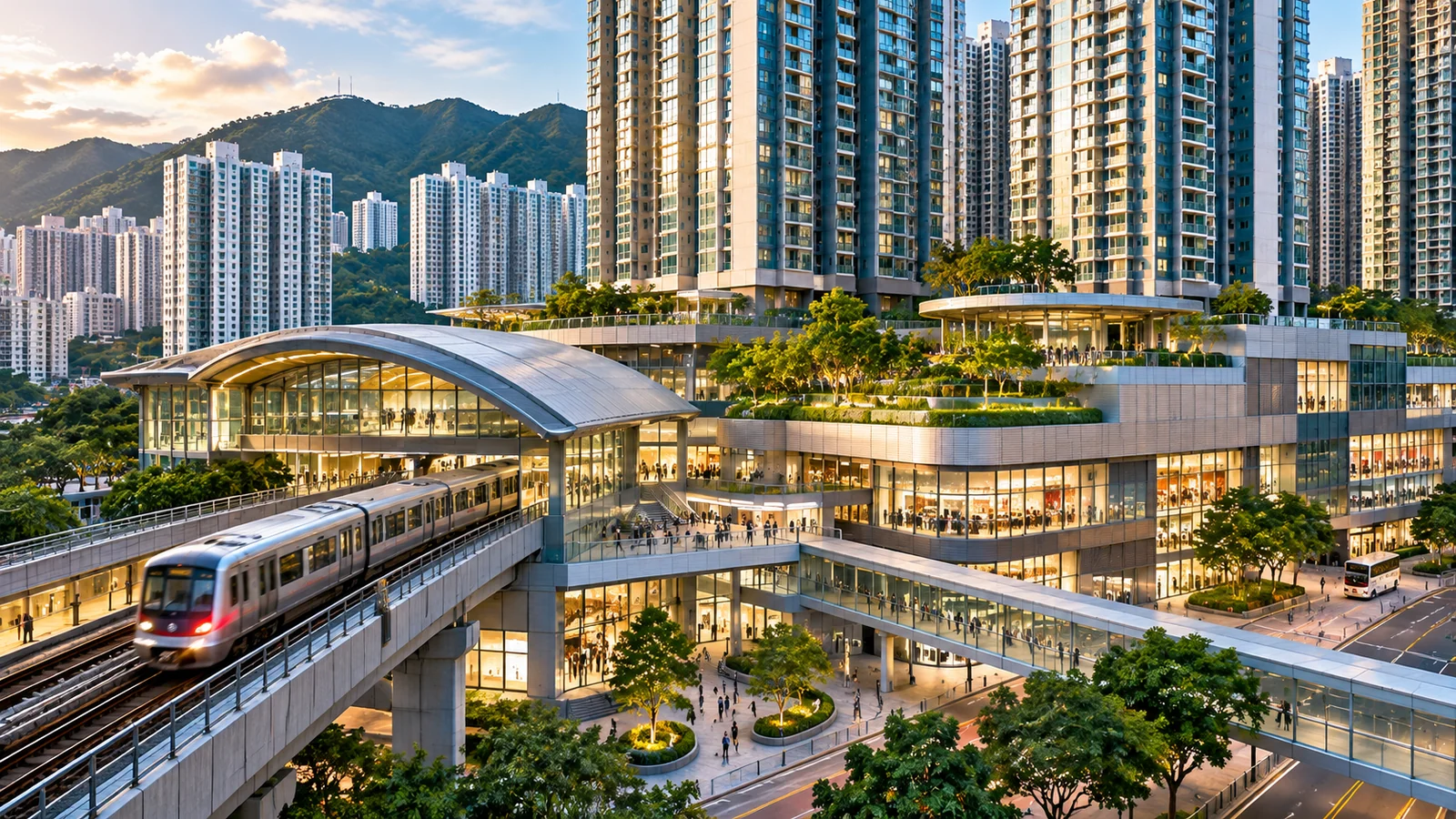
In Hong Kong, a trip to the railway station can involve little more than leaving a residential lobby, crossing a shopping mall and descending to the platforms. Residential towers, shopping centres, pedestrian bridges and transport interchanges are often designed as parts of a single development. This urban pattern is closely associated with MTR’s long-standing Rail plus Property model, usually abbreviated as R+P.
Yet Rail plus Property is not simply another name for buildings above railway stations. It is principally a development and financing arrangement that captures part of the value generated by better transport connections to support railway investment. Over time, it has also helped shape Hong Kong’s urban geography.
1. The Starting Point: Financing an Expensive Railway
Building a modern underground railway requires substantial capital before any fare income is collected. During the development of Hong Kong’s first modern railway network in the 1970s, stations, tunnels, tracks and signalling systems all required major upfront investment. The question was how to finance infrastructure whose economic benefits would materialise over many years.
Railways improve accessibility. Sites near a new station can become more attractive for homes, offices and shops because residents and businesses gain better connections to the rest of the city. Under the concept of land value capture, part of the value associated with improved accessibility can be redirected towards the infrastructure that helped generate it.
Hong Kong began developing property-linked financing arrangements during its early railway era. They subsequently expanded from early urban railway schemes to larger projects associated with the Airport Express and Tung Chung Line, as well as later new-town developments. The arrangements have evolved; it would be misleading to suggest that every project has followed an identical contractual or land-premium formula.
2. How Do the Government, MTR and Developers Work Together?
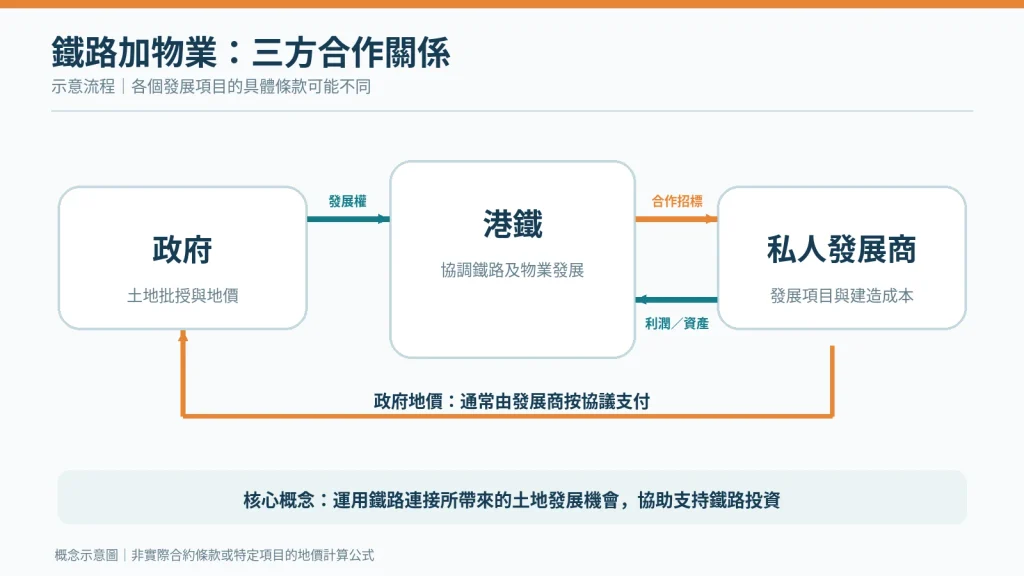
The model is easier to understand by distinguishing three main participants:
- Government: Makes development rights available through the relevant project and land arrangements, and deals with land grants and premiums.
- MTR: Integrates railway and property planning, coordinates the property development programme, tenders development opportunities and receives agreed financial or property interests.
- Private developers: Bid for development packages and typically fund construction and assume substantial property development risks, subject to the applicable land and commercial agreements.
In a simplified transaction, railway-related development rights are made available to MTR under agreed arrangements. MTR then seeks a development partner through a tender process. Depending on the project, the developer pays the applicable government land premium and development costs; MTR receives an agreed share of profits, completed assets or a lump-sum payment.
The precise distribution of costs and proceeds differs between projects. Historical descriptions of land being valued without the railway’s effect should not be confused with the terms of every modern project. MTR’s published investor material makes clear that implementation varies.
Property development profits are also distinct from rental income from investment properties and from railway fares. These different income streams can help support capital investment, railway maintenance and operations. R+P therefore supplements, rather than replaces, the basic business of transporting passengers.
3. Why Are Stations, Homes and Shopping Centres Connected?
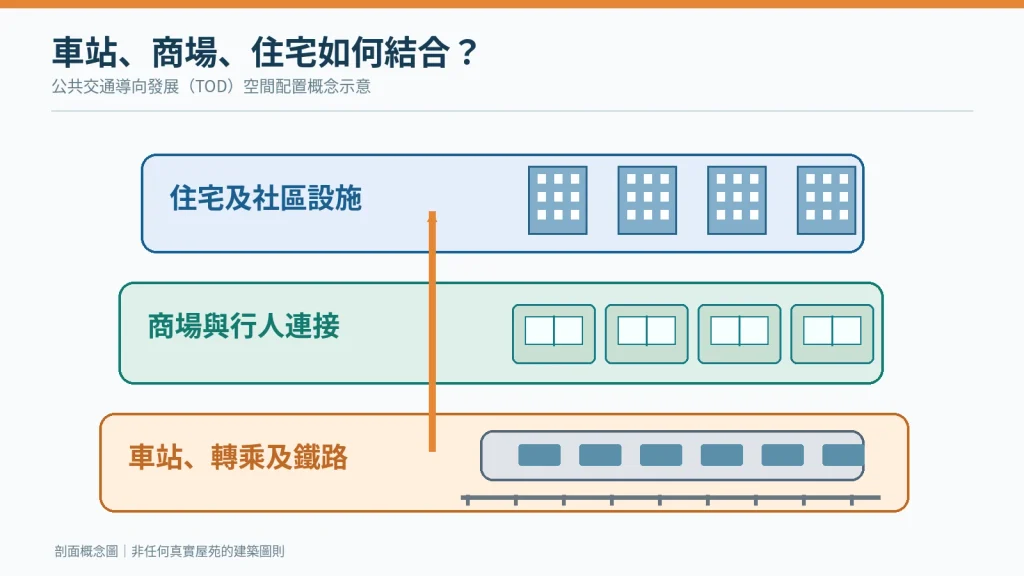
Stations concentrate daily passenger activity. Integrating housing, retail, public transport interchanges and pedestrian facilities in a coordinated design can make everyday journeys shorter and create a convenient location for shops and community services.
A typical integrated development may include a station concourse, bus or minibus interchange, a retail podium, residential towers, landscaped spaces and elevated or covered walkways. Some projects also develop land above or next to railway depots.
This is related to transit-oriented development (TOD), an urban planning approach that concentrates activity around public transport and makes walking and transit more practical for at least some journeys. However, R+P and TOD are not interchangeable. R+P describes the development and financing mechanism; TOD focuses on how places are planned and used.
Direct access to a mall does not automatically guarantee excellent public space. Pedestrian routes, street-level connections, accessibility for different users and the quality of open areas must be assessed at the individual development level.
4. Tsing Yi and LOHAS Park: Two Generations of Development
Tsing Yi provides a clear example of rail, commercial and residential uses being combined around one transport node. According to MTR’s property development information, Maritime Square was completed in 1998 and the adjoining Tierra Verde residential development in 1999, containing approximately 3,500 homes. These projects show how the Airport Railway era supported larger integrated communities.
LOHAS Park in Tseung Kwan O illustrates a different characteristic: phased development. MTR’s official project records show that The Capitol was completed in 2008 and successive residential packages followed over many years. The LOHAS shopping centre was completed as part of later phases. Instead of appearing all at once, the new community gained homes, shops and supporting facilities as the development progressed.
These examples also demonstrate that rail-associated development is not architecturally uniform. Some projects have extensive podium shopping centres; others consist of residential groups, interchanges, landscaped spaces and smaller commercial facilities. A project can be beside a station rather than literally above its platforms.
5. What Are the Benefits and Trade-Offs?
R+P offers several potential advantages when planning and market conditions are favourable:
- Funding support: Property-related proceeds can help bridge financing gaps for railway construction, although they do not guarantee that a line will be fully self-funded.
- Efficient land use: Combining different functions at well-connected sites can make more intensive use of scarce urban land.
- Convenient connections: Covered walkways and integrated interchanges can reduce the time and inconvenience of some daily trips.
- Community formation: Phased housing and commercial development can gradually build a local customer base and support services.
These benefits come with trade-offs. Concentrated development can create high population density and greater pressure on transport, schools and public amenities. Routes organised primarily through shopping centres may offer convenience while also raising questions about street activity and the accessibility of genuinely public space.
The economics are also exposed to property cycles. Tender demand, construction schedules, achievable sales values and commercial rents can change. The presence of a railway does not remove market risk, and the development profits anticipated at the outset may not be realised on the expected timetable.
For residents, the practical questions are straightforward: How long is the journey from home to the platform? Are the connections accessible and convenient? Are public facilities in operation? Can pedestrians reach the surrounding streets without unnecessary detours?
6. What the Model Does—and Does Not—Tell Property Seekers
Good railway connections may enhance a location’s attractiveness, but they do not ensure that every nearby flat will appreciate in value. Nor is every building next to an MTR station necessarily part of a Rail plus Property project. Sale prices and rents remain sensitive to supply, building age, layout, property condition, interest rates and wider market conditions.
Anyone researching a railway-associated development can begin with MTR’s published property development records. It is useful to establish whether the scheme is an MTR property project, how the station connects with the housing, when each phase was completed and whether proposed retail or community facilities are already operating. A feature shown on a master plan should not be presented as an existing amenity.
Conclusion: A Financing Arrangement That Shaped the City
Hong Kong’s Rail plus Property model started from the challenge of financing rail infrastructure and evolved into a wider framework connecting transport, land development and urban planning. Its significance extends well beyond residential towers built above stations. It rests on how the Government, railway operator and development partners cooperate, and how transport investment and property activity interact.
Understanding R+P therefore helps explain why certain neighbourhoods grew around railway nodes, why retail often concentrates beside interchange points and why the benefits of convenience must be balanced against density, urban design and financial risk.