
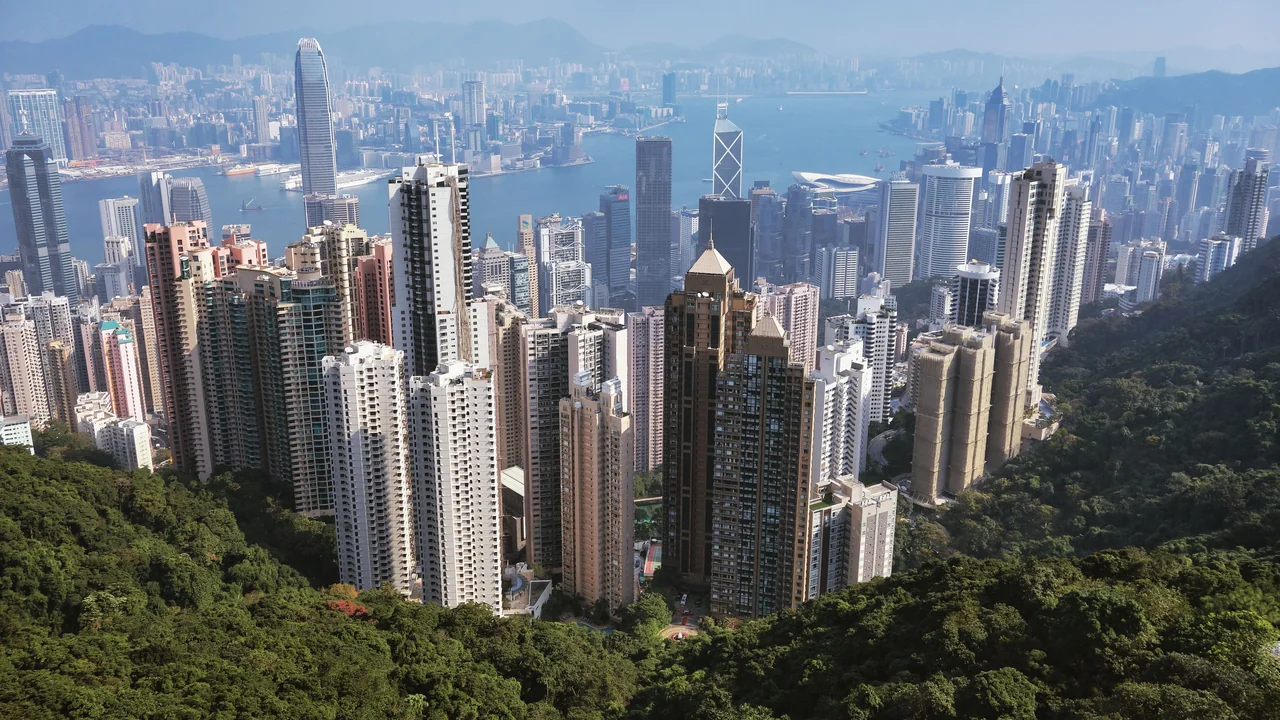
Buyers looking at a mid-tier or luxury home in Hong Kong under the New Capital Investment Entrant Scheme sometimes assume that purchasing a residential property for HK$30 million will itself satisfy the Scheme’s HK$30 million investment requirement. The official rules treat two figures separately: the transaction-price threshold that determines whether a home is eligible to be counted, and the much lower cap on how much of that purchase can be counted towards the minimum investment. A purchase at or above HK$30 million does not, by itself, fulfil the HK$30 million net investment requirement.
This article explains how residential real estate is counted, based on the Rules for the New Capital Investment Entrant Scheme (the Scheme Rules) published by Invest Hong Kong and the Immigration Department, together with the official investment-requirement page and frequently asked questions. The official texts visible on 19 November 2026 (Hong Kong time) were checked for this article. No mid-November 2026 rewrite of the residential-property counting rules was found. This is not personal immigration, tax or conveyancing advice. Applicants should rely on the latest Scheme Rules and on verification by the New CIES Office.
The threshold and the cap are not the same number
As announced in the 2025 Policy Address, the transaction-price threshold for one single residential property was reduced from HK$50 million to HK$30 million, and the aggregate cap on real estate counted towards the minimum investment threshold was raised from HK$10 million to HK$15 million, of which the cap on residential real estate remains HK$10 million. Note (8) to the Scheme Rules states that these amendments apply only to investment in real estate whose date of completion of the purchase is on or after 17 September 2025.
Where the date of completion is on or after 17 September 2025, residential real estate in Hong Kong — including a pre-completion property and multi-purpose real estate used partly for residential purposes — must be one single property with a transaction price of HK$30 million or above before it can be counted. Once it qualifies, no more than HK$10 million of that residential investment can be counted, and all real estate, residential and non-residential, is subject to an aggregate cap of HK$15 million. The threshold decides whether a property can be counted; the cap decides how much of it can be counted.
| Item | Official rule (date of completion on or after 17 September 2025) |
|---|---|
| Minimum investment requirement | Investment of at least HK$30 million net in Permissible investment assets |
| Amount that must be placed in the CIES Investment Portfolio | HK$3 million |
| Remaining Permissible financial assets and/or real estate | At least HK$27 million |
| Transaction-price threshold for one single residential property | HK$30 million or above |
| Cap on residential real estate that can be counted | HK$10 million |
| Aggregate cap on all real estate that can be counted | HK$15 million |
The date of completion decides which rules apply
The Scheme Rules define “Date of completion” as the date of payment on completion, or, if payment is made by more than one instalment, the date of payment of the last instalment. The applicant or entrant is regarded as having made the investment in the real estate on that date. For residential real estate, the date of completion must be on or after 16 October 2024. If it is before 17 September 2025, the investment must still be made in one single property with a transaction price of HK$50 million or above, and the total amount of real estate that can be counted remains subject to an aggregate cap of HK$10 million.
Why a HK$30 million purchase does not complete the investment requirement
An applicant must invest a minimum of HK$30 million net, or the equivalent in foreign currencies, in Permissible investment assets. Of that amount, at least HK$27 million must be invested in Permissible financial assets and/or real estate, and HK$3 million must be placed separately into the CIES Investment Portfolio, which is set up and overseen by the Hong Kong Investment Corporation Limited.
Even if a qualifying residential property is counted at the maximum of HK$10 million, the applicant must still make up the rest of the minimum HK$27 million with other Permissible financial assets and/or qualifying real estate, and must still place the HK$3 million into the CIES Investment Portfolio. The aggregate real-estate cap continues to apply, so the remaining balance cannot be assumed to be fillable entirely with further property. Assets acquired before the launch date of the Scheme are not counted towards the minimum investment threshold.
Only net equity counts if there is a mortgage, and stamp duty is not counted
The official frequently asked questions state that an applicant may use the real estate as collateral to take out or refinance a mortgage with banks or financial institutions licensed in Hong Kong, but only net equity — the portion contributed by the applicant — will be counted as a qualifying investment, subject to the relevant cap in paragraph 5.2 of the Scheme Rules. Even where the transaction price meets the threshold, if the applicant’s own contribution is below the cap, the amount that can be counted is the net equity, not the full transaction price.
The same frequently asked questions also state that charges, fees, commissions, stamp duty, taxes, levies and other expenses incurred in acquiring, disposing of or realising Permissible investment assets will not be counted as committed investment. Stamp duty is a separate transaction cost under the Stamp Duty Ordinance, not part of the amount counted under the Scheme.
Ownership and property type have to fall within the official definitions
The real estate must be held in the applicant’s or entrant’s own name, through a sole proprietorship under that person’s name, or through a company of which that person is the sole shareholder, including a Holding Company as defined in paragraph 1.12 of the Scheme Rules. Residential and non-residential real estate have the meanings of “residential property” and “non-residential property” in section 29A of the Stamp Duty Ordinance (Cap. 117). Multi-purpose real estate used partly for residential purposes is subject to the single-property residential threshold. There is no restriction on the number of non-residential properties an applicant may acquire, but the aggregate cap still applies. Illegal or unlawful use or occupation of land, as well as boats, houseboats, trailers, caravans, illegal structures and cocklofts, cannot be counted.
The amendments to the Scheme Rules on 1 March 2026 concern the conditions of an eligible private company and family-owned investment holding arrangements. They do not change the residential threshold or the counting caps. A separate designated-account rule, applicable to applications for Net Asset Assessment submitted on or after 1 November 2026, concerns Permissible financial assets, not real estate itself.
Check the official texts before deciding
Residential real estate can be one of the Permissible investment assets under the Scheme, but a transaction price of HK$30 million is only the threshold for being counted. It is not proof that the HK$30 million investment requirement has already been met. Anyone considering a mid-tier or higher-value private home for this purpose should check the date of completion, the transaction price, the net equity, and whether the rest of the required investment has been arranged under the official rules. The governing texts are the Scheme Rules, the investment-requirement page and the frequently asked questions on the New CIES website. Before making any application or purchase, it is advisable to enquire directly with the New CIES Office and, where needed, to consult a qualified professional adviser.