
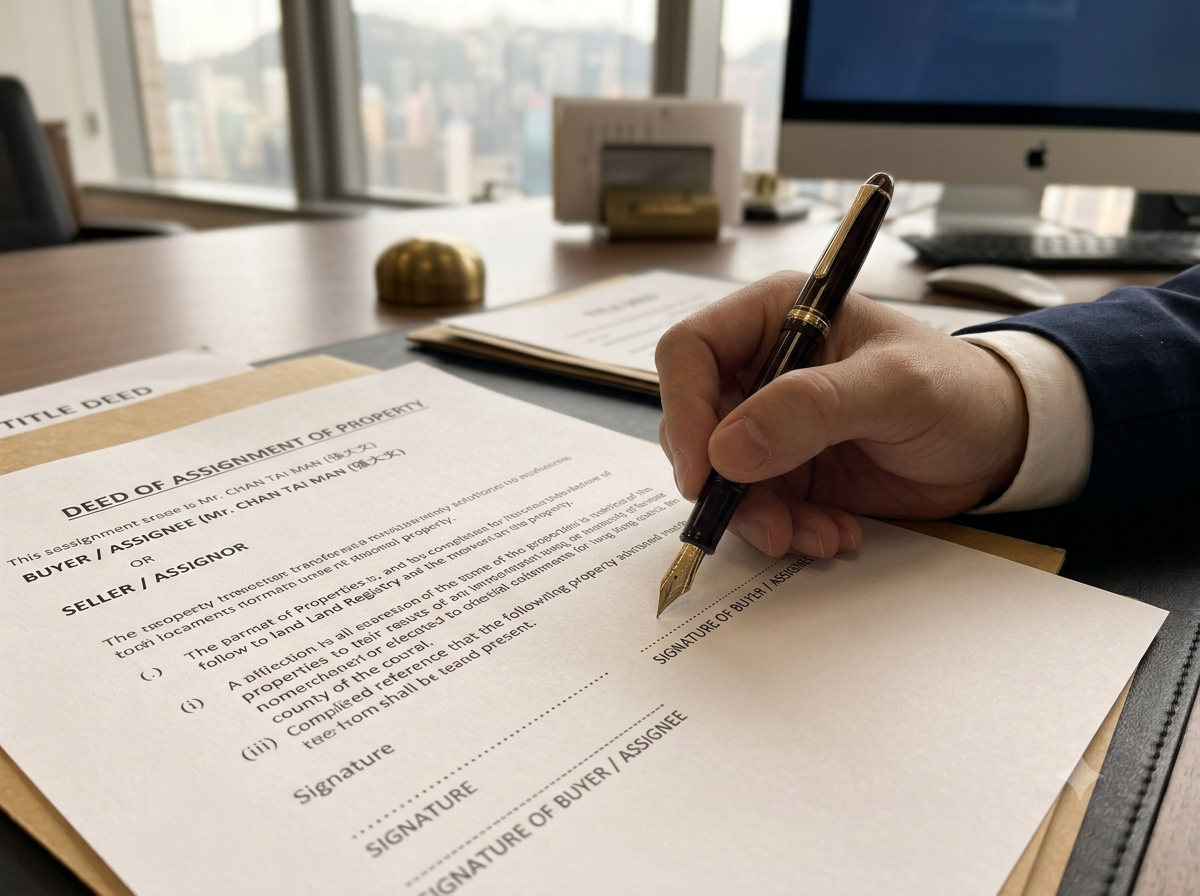
Once you have found the right flat and agreed a price, the emotional part of buying property in Hong Kong gives way to a precise legal sequence. Conveyancing — the process of transferring legal ownership from vendor to purchaser — is where a deal is either secured or quietly unravels. It is also the stage where many first-time buyers feel least informed, signing documents whose consequences they only half understand. This guide walks through the process from the provisional agreement to the day you collect the keys, so you know what each step commits you to and where the real risks lie.
What Conveyancing Means in Hong Kong
Conveyancing is the legal machinery that turns a handshake into registered ownership. In Hong Kong the process is document-driven and time-bound: dates in the contract are treated as strict deadlines, and missing one can cost you your deposit or expose you to a claim. Unlike in some jurisdictions, it is normal and expected for both the purchaser and the vendor to instruct their own solicitors, who then correspond to move the transaction forward. The solicitor’s role is not merely to witness signatures but to verify that the seller genuinely owns the property, that the title is good and marketable, and that nothing — an unauthorised structure, an outstanding charge, an unpaid management fee — will follow you after completion.
Because the timetable is short, often only a matter of weeks, preparation matters. Buyers who line up their financing, their solicitor and their deposit funds in advance move through the process calmly. Those who improvise tend to discover problems at the worst possible moment.
Step One — The Provisional Agreement for Sale and Purchase
The first binding document is usually the provisional agreement for sale and purchase, prepared by the estate agent and signed by both parties, frequently on the same day an offer is accepted. Despite the word “provisional”, this is a legally binding contract. On signing, the purchaser pays an initial deposit, and the agreement fixes the essential terms: the price, the identity of the property, the completion date and the amount of any further deposit.
It is worth pausing here, because buyers routinely underestimate this document. Once signed, you are committed. If you later withdraw without a contractual right to do so, you can forfeit the deposit; a vendor who pulls out may be liable to pay you an equivalent sum. Before signing, satisfy yourself that the property description matches what you inspected, that the completion date is realistic for your mortgage drawdown, and that any special conditions — vacant possession, inclusion of fixtures, tenancy arrangements — are written in rather than merely promised.
Step Two — Instructing Your Solicitor and the Formal Agreement
Shortly after the provisional agreement, each side’s solicitor prepares and the parties sign the formal agreement for sale and purchase. This more detailed contract supersedes the provisional one and sets out the full terms of the sale, the completion mechanics and the obligations of each party. At this stage the purchaser typically pays a further deposit, bringing the total deposit up to the agreed figure held pending completion.
Choosing a solicitor is not a step to rush. Look for a firm experienced in Hong Kong residential conveyancing, ideally one on your lender’s approved panel, since a bank will usually insist that the same or an approved firm handles the mortgage side. Ask upfront for a clear quotation covering both the professional fee and disbursements such as land search fees and registration charges. A good solicitor will explain the timetable, flag anything unusual in the title, and tell you plainly if a property carries risks worth reconsidering.
Step Three — Title Investigation, Requisitions and the Mortgage
With the formal agreement signed, the purchaser’s solicitor investigates title. This means examining the chain of ownership, reviewing the deed of mutual covenant and the government lease, conducting a land search at the Land Registry, and raising “requisitions” — formal questions to the vendor’s solicitor about anything that appears unclear or defective. Common concerns include outstanding mortgages that must be discharged on completion, unauthorised building works, and whether management fees, rates and government rent have been paid up to date.
In parallel, the purchaser finalises the mortgage. The lender instructs its own or the buyer’s solicitor to prepare the mortgage documentation, and loan funds are arranged to be available on the completion date. It is prudent to keep your solicitor and mortgage broker or banker talking to one another, because a delay in loan approval is one of the most common reasons a completion date slips. If the title investigation uncovers a defect the vendor cannot cure, your solicitor will advise whether you are entitled to walk away or to require the problem be resolved before you pay the balance.
Step Four — Completion and Handover
Completion is the moment ownership legally transfers. On the agreed date the balance of the purchase price is paid, usually by cashier’s order, in exchange for the executed assignment and the title deeds. The purchaser’s solicitor then registers the assignment at the Land Registry, and any stamp duty payable on the transaction is dealt with within the required time. If a mortgage is involved, the lender’s charge is registered at the same time.
In practice, the keys and vacant possession are handed over on or around completion. Sensible purchasers arrange a final inspection shortly before completing, to confirm the property is in the promised condition, that agreed fixtures remain, and that the previous owner has removed their belongings. Once completion has taken place and registration is done, you are the legal owner — and the responsibilities of ownership, from management fees to rates, pass to you.
Common Pitfalls and How to Protect Yourself
The most frequent problems are avoidable. Signing a provisional agreement without understanding its binding force, underestimating how tight the completion timetable is, and leaving mortgage approval until the last minute together account for a large share of failed or fraught transactions. Buyers also sometimes assume that verbal promises about repairs or included furniture will be honoured; if it is not in the written agreement, treat it as decoration rather than a term.
Protect yourself by instructing your solicitor early, reading every document before you sign rather than after, and keeping a realistic buffer in your timetable and your finances. Confirm that funds for each deposit and the final balance will be available exactly when required. Above all, ask questions: a conveyancing solicitor is paid to explain, and the cost of a clarifying conversation is trivial next to the cost of a deposit lost to a misunderstanding.
The takeaway: Hong Kong conveyancing is orderly and predictable when you respect its deadlines and lean on professional advice. Understand what the provisional agreement commits you to, instruct an experienced solicitor, keep your financing on schedule, and inspect before you complete. Do that, and the walk from offer to keys becomes a formality rather than a source of anxiety.