
In Hong Kong’s fast-moving property market, the estate agent is often the first professional a buyer or seller meets — and sometimes the only one they deal with until a solicitor is instructed. A capable agent can open doors, sharpen your negotiating position and steer a transaction through to completion. But the relationship is a commercial one, shaped by law and by a signed agreement that many people skim rather than read. Understanding how agency actually works here helps you secure better service and avoid unwelcome surprises.
This guide explains what a licensed agent is required to do, what you are committing to when you appoint one, how commission is calculated and paid, whose interests the agent is really serving, and how to protect yourself throughout the process.
A Licensed Profession, Not a Free-for-All
Estate agency in Hong Kong is regulated by the Estate Agents Authority (EAA), a statutory body established under the Estate Agents Ordinance. Anyone who handles property transactions for a fee — whether an individual salesperson or the agency itself — must hold a valid licence. Before engaging anyone, it is worth confirming their licence status; the EAA maintains a public register that lets you check an individual or a company in moments. A licensed agent is bound by a code of conduct requiring honesty, fair dealing and the protection of clients’ interests.
The distinction matters. An unlicensed operator is not subject to these obligations, and you would have far less recourse if something went wrong. Asking to see a licence at the first meeting is entirely normal, and a professional agent will not be offended by the request. It also pays to note the licence number on any documents you sign, so there is no ambiguity later about who represented you.
Understanding the Estate Agency Agreement
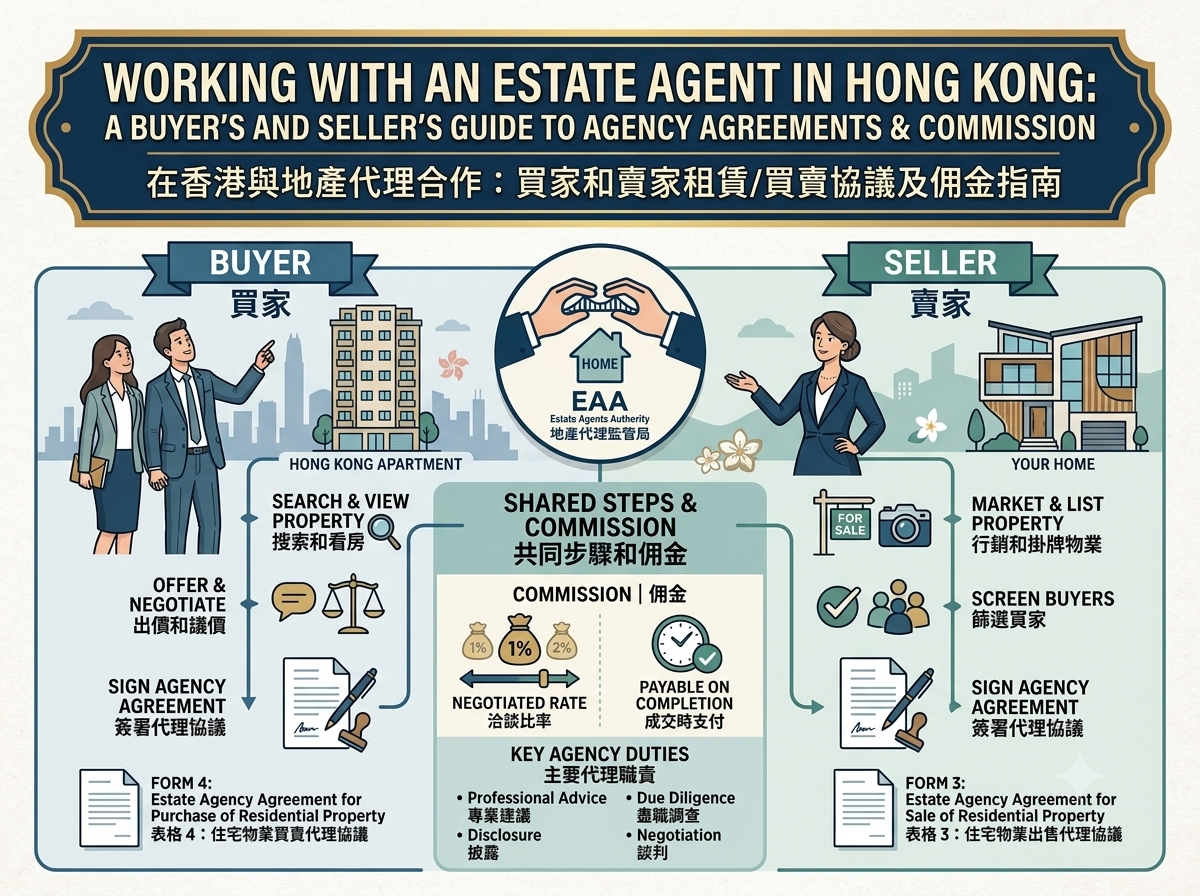
When you formally appoint an agent, you sign an estate agency agreement. This is not a mere formality: it sets out the agent’s authority, the commission rate, the duration of the appointment and the property or search brief. For sellers, the agreement will usually specify whether the appointment is exclusive — a sole agency — or open to several agents at once.
Read the term carefully. An exclusive listing commits you to one agency for a fixed period, during which commission may be payable even if you find a buyer yourself. Open listings give you flexibility but can mean less dedicated effort from any single agent. For buyers, the agreement records the specific properties you are being introduced to, which becomes important if a dispute later arises over who introduced you to a particular flat. Never sign a blank or partially completed form, always keep your copy, and if a clause is unclear, ask for it to be explained before you sign rather than afterwards.
How Commission Works
Commission is the agent’s fee for a completed transaction and is customarily expressed as a percentage of the sale price or, for lettings, of the monthly rent. In Hong Kong sales it is common for the agency to collect commission from both the buyer and the seller, with a customary rate of around one per cent from each side — though this is negotiable and should always be confirmed in writing before you commit.
Two points deserve emphasis. First, commission generally becomes payable when the transaction reaches a defined milestone — often the signing of the provisional agreement for sale and purchase — rather than only at final completion, so be clear about the trigger before you sign anything. Second, if the deal falls through, whether commission is refundable depends on the wording of your agreement and the reason for the collapse; this is precisely the kind of detail worth clarifying at the outset rather than in the heat of a dispute.
Whose Side Is the Agent On?
This is the question buyers and sellers most often overlook. In many Hong Kong residential deals the same agency acts for the buyer and the seller simultaneously. This dual agency is lawful, but it means the agent cannot wholeheartedly champion one party’s price against the other’s. The code of conduct requires the agency to disclose the arrangement, obtain the consent of both clients and treat them even-handedly — but you should calibrate your expectations accordingly.
If you want an adviser who is unambiguously on your side — particularly as a buyer negotiating hard on price — consider appointing an agent on a single-agency basis, or lean more heavily on your solicitor and your own research for independent judgement. Be candid with your agent about your budget and priorities, but remember that in a dual-agency setting anything you disclose could indirectly inform the other party’s stance.
Doing Your Own Due Diligence
A good agent will help you gather information, but the legal responsibility for checking a property rests with you and your solicitor. Use the agent to arrange viewings, obtain the property’s particulars and clarify what is included in the sale, then verify the important facts independently. That means a land search at the Land Registry, confirmation of the saleable area, a check for any unauthorised building works, and a review of the deed of mutual covenant along with any outstanding management fees.
The provisional agreement for sale and purchase is a binding contract, so instruct a solicitor before you sign it, not after. A conscientious agent will encourage you to take legal advice; be wary of anyone who pressures you to sign immediately, waives your need for a solicitor, or discourages you from carrying out standard checks.
The Takeaway
An estate agent can be a genuine asset in a Hong Kong property transaction, but the relationship works best when you understand its commercial and legal shape. Check the licence, read the agency agreement, confirm the commission and its trigger in writing, know whether the agent is acting for both sides, and never let the convenience of a helpful agent replace your own due diligence and independent legal advice. Approached this way, you gain the benefit of local expertise while keeping control of the decisions that matter most.