
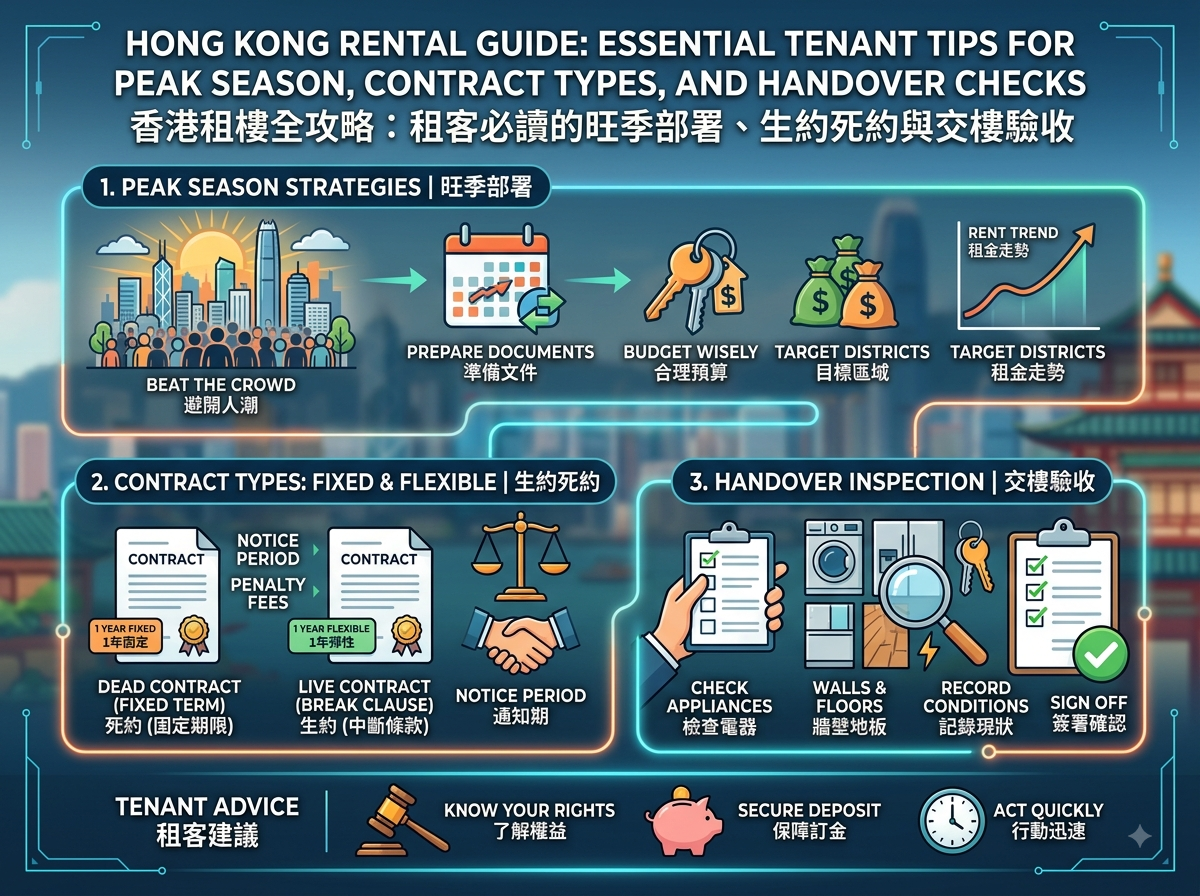
Every summer Hong Kong’s lettings market tightens. Universities confirm their intakes, companies finalise transfer paperwork, and a fresh cohort of arrivals under the talent admission schemes begins viewing in earnest. Agents call it the busy season. For tenants it is the least forgiving time of year to arrive unprepared — good flats are let within days, landlords have little reason to discount, and the pressure to sign quickly is at its highest.
Renting well in Hong Kong is less about finding a bargain than about understanding a tenancy structure that is unusual by international standards, and about knowing which terms are genuinely negotiable. This guide walks through the tenant’s side of that process: when to start, what the true cost is, how Hong Kong tenancies are built, and how to protect the deposit you will want back in two years’ time.
Why timing matters more than most tenants expect
Hong Kong’s rental cycle is driven by the academic calendar and the corporate relocation calendar, and the two overlap through the summer months. Demand concentrates around university catchments and the estates that offer small, well-connected units, while family-sized flats in established residential districts see a parallel wave from relocating households who want to be settled before the school term.
The practical consequence is that supply and bargaining power move together. Start your search at the peak and you are competing with the largest pool of tenants of the year; start earlier, or later, and you will usually see more patient landlords. If your move-in date is fixed by an employer or a term start, build in a viewing window of several weeks rather than several days. Tenants who compress the search into a single weekend almost always pay for it — either in rent, or in accepting a flat that does not really suit them.
It is also worth being realistic about what your budget buys in different districts. The same monthly figure produces a very different flat in a mature estate near an MTR interchange than it does in a newer development further out, and the trade-off is usually space against commuting time. Deciding which of the two you care about before you start viewing will save a great deal of wasted travel.
What this summer’s lettings actually look like
Three Hong Kong Island lettings recorded on 11 and 12 August 2026 show how uneven the market is beneath the headline rents. At Kennedy 38 in Kennedy Town, a 228 sq ft open-plan unit on a low floor was let at HK$20,000 a month — about HK$87.7 per square foot of saleable area. At a small development in Sai Ying Pun (瑧蓺), a 222 sq ft studio was asking HK$19,000 and let at HK$18,000, or roughly HK$81.1 per square foot. At Headland in Chai Wan (海德園), a 437 sq ft one-bedroom flat was asking HK$24,000 and let at HK$21,000 — about HK$48.1 per square foot.
That spread is the single most useful thing a tenant can take from the data. The Chai Wan flat is almost twice the size of the two studios for only a modest step up in monthly rent, because it costs little more than half as much per square foot. Compare on monthly rent alone and the studios look like the budget option; compare per square foot and they are the expensive one. Work out the rate per square foot for every flat on your shortlist and you will see immediately how much of your rent is buying space, and how much is buying newness and a short walk to the station.
Two patterns in the same figures are worth noting. First, two of the three let below the initial asking rent — the Chai Wan flat by HK$3,000 a month — which is a useful corrective to the assumption that peak season means fixed prices. Second, in both studio lettings the incoming tenant, a mainland student in each case, secured the flat by paying a full year’s rent in advance. Roughly 120 letting transactions were recorded in Mid-Levels West in the first ten days of August alone, which gives a sense of how compressed the season is and why tenants reach for that kind of lever.
Paying a year upfront is a real advantage in a competitive market, but weigh it carefully. It hands over a large sum with no straightforward route to recovering it if the arrangement sours or the landlord’s circumstances change, and it is worth taking advice before treating it as a routine concession.
Figures above are as recorded in market transaction records on 11 and 12 August 2026 and describe individual transactions, not market averages.
The real cost of renting, beyond the monthly rent
The headline rent is only part of what a tenant commits to. Before signing, work out the full sum you will need to have available, because several of these payments fall due at once.
A security deposit is standard practice and is commonly set at two months’ rent, held by the landlord for the duration of the tenancy and returned after handover, less any agreed deductions. Where an agent is involved, an agency commission is payable, conventionally calculated as a proportion of one month’s rent and shared between the two sides. Stamp duty is payable on the tenancy agreement itself, calculated on a statutory scale that varies with the length of the term — check the current rates with the Inland Revenue Department rather than relying on a figure quoted second-hand.
Then there are the recurring costs. Government rates and, in some cases, government rent may be payable by either party depending on what the agreement says, so read that clause rather than assuming. Management fees are more often the landlord’s responsibility, but this is not universal. Utilities, broadband and any car parking space are ordinarily the tenant’s, and utility accounts usually require their own deposits. Adding these together before you commit avoids the common experience of a first month that costs far more than expected.
Fixed term and break clause: how Hong Kong tenancies are structured
The feature that most surprises tenants new to Hong Kong is the two-part term. A residential tenancy here is commonly written for a total of two years, split into an initial period during which neither party may terminate early, followed by a period during which either side may end the tenancy by giving notice. In everyday Cantonese these are described as the “dead” and “live” portions of the lease; in the agreement itself the second is a break clause.
This structure is genuinely useful once you understand it. It gives the landlord a guaranteed minimum period of income and gives the tenant a route out without forfeiting the deposit, provided the required notice is given correctly. What matters is the detail: when the break clause becomes available, how much notice is required, whether notice must be in writing, and whether it can be served to expire on any date or only at the end of a rental month.
Two points are worth negotiating rather than accepting as printed. First, the length of the initial fixed period — a tenant whose plans are uncertain has a legitimate interest in a shorter one, and landlords facing a quieter market are sometimes willing. Second, symmetry: check whether the break clause is available to both parties or only to the landlord, because the two are not the same and the difference will matter if your circumstances change.
Viewing with a tenant’s eye
Tenants tend to view flats the way buyers do, concentrating on layout and outlook. Those matter, but the things that make a tenancy pleasant or miserable are more mundane, and most of them can only be checked in person.
Run the taps and the shower and watch the water pressure, particularly in older buildings and on higher floors. Turn on every air conditioning unit and listen to it — in a Hong Kong summer, a noisy or underpowered unit in the bedroom is a serious problem. Look for signs of water ingress around window frames, along ceiling lines and in bathrooms, which is where most disputes about condition eventually arise. Open the windows and listen: proximity to a main road, a refuse collection point or a school playground is far more apparent at street level than on a floor plan.
Ask what is included. Whether appliances, curtains, light fittings and any furniture stay with the flat should be established at the viewing and then recorded in writing, along with who is responsible for repairing them if they fail. A verbal assurance from an agent that the landlord will replace the washing machine is worth nothing once the agreement is signed.
Finally, ask practical building questions. Is there a lift refurbishment or major maintenance programme scheduled? What are the rules on deliveries, moving in and out, and pets? Estates vary considerably, and these restrictions are rarely volunteered.
Handover, inventory and protecting your deposit
Most deposit disputes are not really disputes about damage. They are disputes about evidence, and they are won or lost on the day the keys change hands.
Before moving in, photograph the flat thoroughly — every room, the condition of the floors and walls, the inside of cupboards, the state of the appliances, and any existing marks or defects. Date-stamped images cost nothing and settle arguments instantly. Where an inventory or condition schedule is provided, go through it carefully rather than signing it as a formality, and add anything the landlord has missed. If no inventory is offered, prepare one yourself and send it to the landlord or agent so there is a record that it was shared.
Take meter readings on the day of handover and confirm which utility accounts are being transferred. Establish how the landlord wishes to be contacted about repairs, and keep those requests in writing throughout the tenancy — a message trail showing that a leak was reported promptly is the single most useful thing a tenant can have if responsibility is later questioned.
Fair wear and tear is expected and is not a proper basis for a deduction; genuine damage is. The distinction is easier to argue when you can show what the flat looked like when you arrived.
Stamping, renewal and moving on
A tenancy agreement should be stamped with the Inland Revenue Department within the statutory time limit. Stamping is not what makes the agreement valid, but a stamped agreement is admissible as evidence in court, which is precisely when a tenant most needs it. The duty is normally shared, and a tenant should confirm that stamping has actually been done rather than assume the landlord or agent has handled it.
When the term approaches its end, both sides face a decision. Landlords weigh the cost of a vacant period and a fresh round of commission against the rent a new tenant might pay; tenants weigh the cost and disruption of moving against the terms on offer. That balance is what makes renewal negotiable, and a reliable tenant who has paid on time has more leverage than they often realise. Open the conversation well before the notice deadline rather than after it.
If you are leaving, give notice exactly as the agreement requires, in the form it requires. Arrange the final inspection, return the flat clean and empty, hand over every set of keys and access cards, and settle the utility accounts. Then ask for the deposit refund in writing, with a date.
The takeaway
Renting in Hong Kong rewards preparation more than negotiation. Start the search before the market is at its busiest, budget for the deposit, commission and stamp duty alongside the rent, read the break clause carefully enough to know when and how you can leave, and document the flat’s condition on the day you move in. Those four habits will do more to protect a tenant than any amount of haggling over the monthly figure — and they cost nothing but attention.