
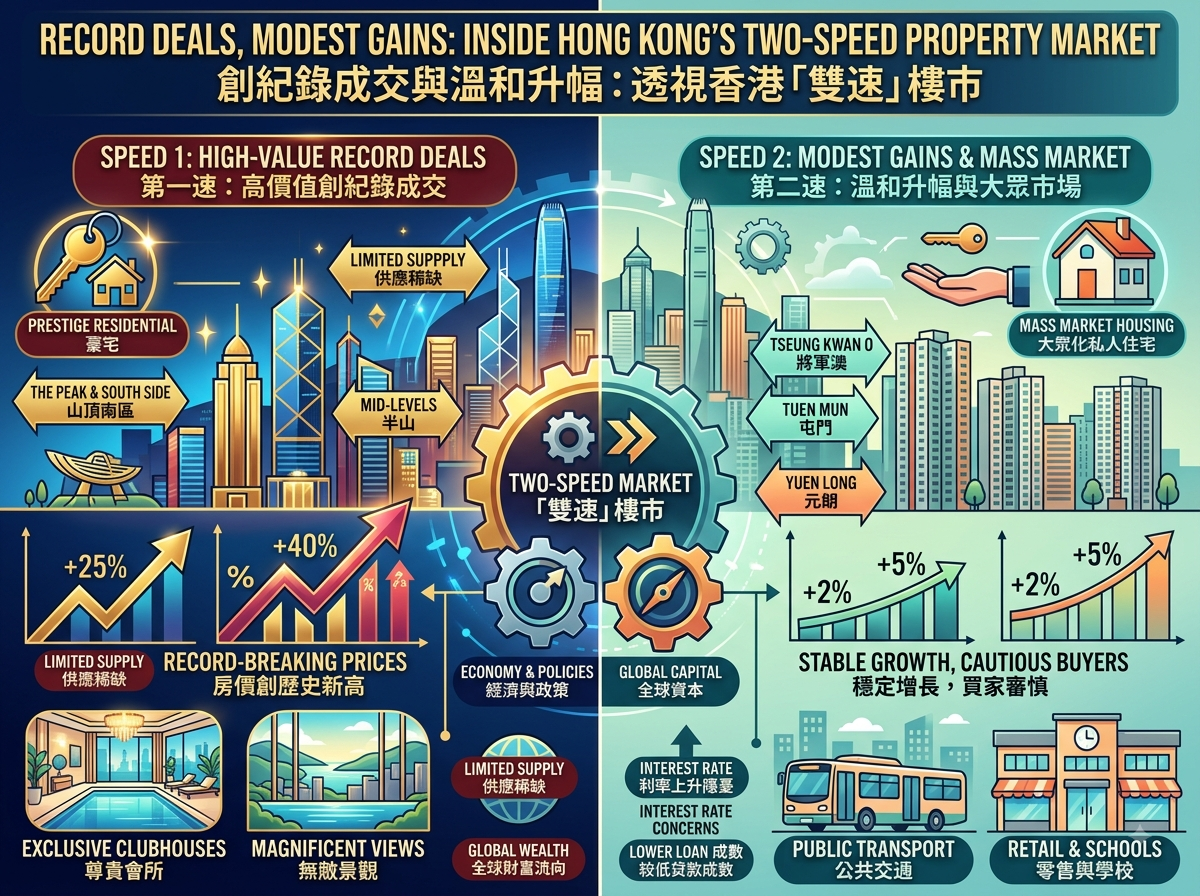
Two things are true about Hong Kong’s residential market this summer, and they sit awkwardly together. Transaction volumes are running at their strongest in years, with both the top of the market and cross-border buyers setting records in the first half of 2026. Yet official price growth has been comparatively restrained, and a number of forecasters expect the momentum of the past twelve months to ease over the remainder of the year.
That gap between activity and price is the most interesting feature of the current market, and it is routinely flattened in commentary that treats a busy market and a rising market as the same thing. They are not. What follows sets out what the publicly available data records as at 10 August 2026 — and, just as importantly, what it does not.
What the Land Registry Actually Recorded
The Land Registry’s monthly statistics are the closest thing Hong Kong has to an official pulse reading. For June 2026, the most recent month published at the time of writing, 7,650 sale and purchase agreements for residential units were received for registration. That was 7.2 per cent above May and 28.5 per cent above June 2025. The total consideration attached to those agreements was HK$75.6 billion, up 15.3 per cent month on month and 23.8 per cent year on year.
Across the first half of 2026, the Registry received 49,955 agreements for all building units, residential and non-residential combined — a 35.6 per cent increase on the first half of 2025, with total consideration of HK$410.29 billion.
One technical point matters here and is frequently overlooked. These are registrations, not signings. An agreement reaching the Registry in June may have been negotiated in April or May. Monthly figures therefore describe decisions already taken rather than sentiment in the week they are published, and a strong month can reflect a burst of activity that has since passed.
The Top of the Market Moved Fastest
Within that broad recovery, the high end moved further and faster than the average. Primary-market transactions of private residential property valued above HK$50 million reached 296 cases in the first half of 2026, against 164 in the same period of 2025 — an increase of 80.5 per cent. By value the shift was starker still: roughly HK$30.33 billion against HK$15.06 billion, more than a doubling.
The secondary market at the same threshold showed a similar direction of travel, with 172 transactions above HK$50 million by the end of June, compared with 108 a year earlier, a rise of 59.3 per cent. In the first quarter, deals above HK$100 million were reported to have risen by around 156 per cent year on year.
Percentage changes of that magnitude deserve a word of caution. The ultra-prime segment deals in small absolute numbers, and small numbers produce dramatic percentages. A handful of large transactions completing in one half-year and not the next can move the figure by tens of percentage points without indicating any broad change in conditions.
Cross-Border Capital Crossed a Threshold
The most quantitatively significant development of the half-year was the scale of mainland Chinese participation. Purchases registered under Mandarin pinyin names reached 9,776 deals in the first six months of 2026, with aggregate consideration of HK$107.1 billion. It was the first time this cohort had exceeded HK$100 billion in a six-month period. On deal count, the average outlay worked out at approximately HK$10.97 million.
The activity was spread across both halves of the market. Primary-market purchases accounted for 4,704 deals worth some HK$61.45 billion, up 25 per cent by volume and 22 per cent by value year on year. Secondary purchases numbered 5,072 transactions totalling around HK$45.65 billion, up 24 per cent and 31 per cent respectively — the faster value growth in the secondary market suggesting buyers were not confined to new launches.
Geographically, Kai Tak led the city on both measures, logging roughly 1,161 transactions worth around HK$17.5 billion. Ho Man Tin recorded approximately 299 deals totalling some HK$5.94 billion, an average of about HK$19.8 million each. Government talent admission schemes, which have attracted close to 280,000 professionals from overseas and the mainland, are widely cited as part of the underlying demand picture, alongside the removal of the previous cooling measures.
A serious caveat attaches to all of these figures. “Mainland buyer” here is inferred from the romanisation of the name on the registered instrument. That is a proxy, not a measurement. It will miss mainland purchasers who buy through Hong Kong companies, offshore vehicles or family trusts, or who register under an English name; and it will capture some Hong Kong residents and other purchasers whose names happen to be recorded in pinyin. The direction of the trend is well supported. The precise level is not.
Why the Price Index Has Not Kept Pace
Against that backdrop, the official price series has been comparatively sober. The Rating and Valuation Department’s private domestic price index recorded a sustained run of consecutive monthly gains through the early part of 2026, including a 1.6 per cent month-on-month rise in February, with cumulative recovery from the trough in the region of 8 per cent for second-hand stock. Real, but a long way short of the percentage changes seen in the transaction counts.
Several mechanics explain the divergence. Volume responds to changed conditions faster than price does: buyers and sellers who have been apart for months transact when the gap closes, and the first evidence of that is a rise in deal count rather than a jump in values. There is also a composition effect. A half-year in which unusually many expensive properties change hands raises total consideration sharply while telling you relatively little about what a comparable flat is worth. And the RVD index is territory-wide and dominated by mass-market stock, so a strong run at the top end is heavily diluted by the time it reaches the headline number.
The most recent weekly indicators have been softer still, with secondary home prices easing for a second consecutive week in early August. Weekly series are volatile and should not be over-read, but they are a reminder that the trend has not been uniformly upward.
The Second-Half Question
Forecasts for the remainder of 2026 cluster around modest gains rather than continuation of the first-half pace. Projections for luxury prices have ranged from around 2 per cent to as much as 8 per cent for the full year, with agents generally describing the segment as resilient but expecting price growth to stay mild. A commonly cited risk to the second half is the equity market: weakness in Hong Kong stocks tends to reduce both the paper wealth and the confidence of the buyer pool that transacts at the top end, and several forecasters expect that to take some heat out of the rally.
Whether that materialises is not something this article will attempt to predict, and readers should be sceptical of anyone who claims to know. What can be said is that the conditions producing record volumes in the first half — pent-up demand, removed cooling measures, an expanded resident population through talent schemes and a perception that valuations had corrected far enough — are conditions that release a stock of postponed decisions. That release is, by its nature, finite.
What Volume Data Can and Cannot Tell You
Three limits are worth holding in mind when reading any of the numbers above. First, consideration recorded at the Land Registry is the price agreed between the parties on that instrument. It is not an independent valuation, and in transfers between related parties it may not reflect open-market value at all.
Second, and more broadly, an asking price is not an achieved price. Listing figures record what a seller hopes to obtain; the gap between asking and achieved is negotiated privately and is rarely published in any systematic form. Any assessment built on advertised prices is therefore measuring intention rather than outcome.
Third, averages conceal dispersion. An average mainland purchase of HK$10.97 million spans everything from a modest flat in an outlying district to a nine-figure house, and the mean tells you almost nothing about the typical transaction. The same applies to district figures, where a small number of large deals can dominate an apparently representative total.
None of this makes the data useless. It makes it evidence to be weighed rather than a verdict to be quoted. On the weight of that evidence, the first half of 2026 was a period of exceptional activity and unexceptional price movement — a market that got much busier considerably faster than it got dearer.
About the Data
Figures in this article are drawn from publicly available sources and are stated as at 10 August 2026. Transaction and consideration data come from the Land Registry’s monthly statistics, the most recent published month at the time of writing being June 2026; price index references are to the Rating and Valuation Department’s private domestic price index, which is published monthly in arrears. Luxury segment transaction counts, mainland purchaser estimates and market forecasts are drawn from published press reporting of agency research, and the mainland purchaser figures are based on the romanisation of names on registered instruments, which is an approximation rather than an exact measure. Readers should consult the Land Registry and Rating and Valuation Department directly for the latest published month.
Asking prices are not achieved prices, and the difference between the two is rarely published. All property information is provided for reference only. No representation or warranty is given as to its accuracy, validity, timeliness or completeness. This article is general commentary and is not investment, legal or financial advice. Readers should carry out their own independent verification and take professional advice before entering into any agreement or acting in reliance on anything set out here.