
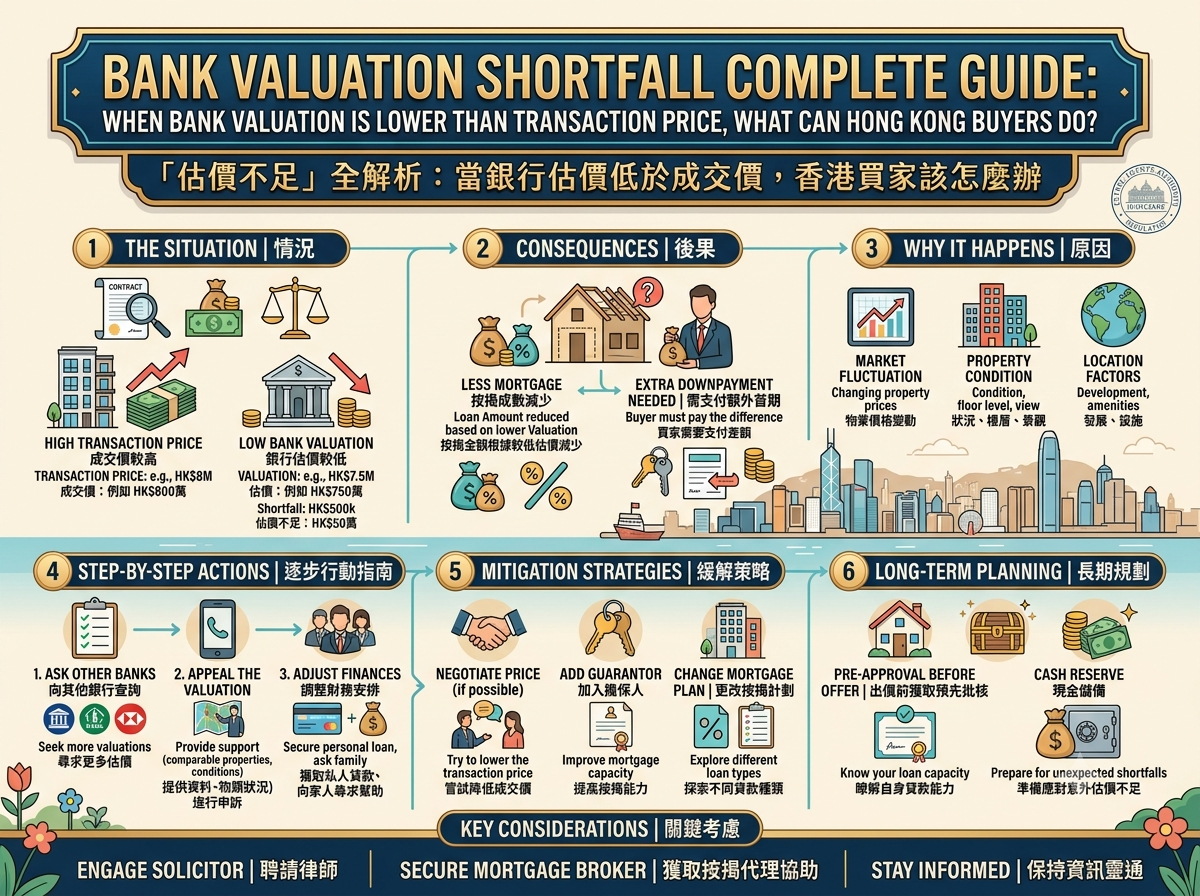
Most Hong Kong buyers spend weeks working out whether they can afford a flat, only to discover late in the process that the bank does not agree with them about what the flat is worth. The price has been negotiated, the provisional agreement signed, the initial deposit paid — and then the mortgage offer arrives with a loan smaller than expected, because the bank’s valuation has come in below the agreed price.
This is what the market calls a valuation shortfall, or “估價不足”. It is not unusual, and it does not necessarily mean you have overpaid. But it is one of the few problems in a Hong Kong purchase that can turn a comfortable transaction into a scramble for cash within days, because your deposit is already committed by the time the number appears.
This guide explains how bank valuation works here, why valuations come in low, what a shortfall does to the cash you need at completion, and the checks that reduce the risk before you sign anything.
How Bank Valuation Actually Works in Hong Kong
A lender does not lend against the price you agreed. It lends against the lower of the purchase price and its own valuation of the property. That single principle is the source of almost every shortfall problem, and it is worth committing to memory before you start viewing.
For flats in large, actively traded estates, banks rely heavily on electronic valuation systems keyed to the building, floor, flat and saleable area. This is why an agent or mortgage broker can often produce an indicative figure within minutes. The model is drawing on registered transactions in the same or comparable buildings, adjusted for floor level, orientation, view, size and condition.
For anything outside that pattern — village houses, older tenement buildings, houses, flats sold with a roof, garden or car parking space, or units with an unusual layout — the automated figure is less reliable or unavailable, and the bank is more likely to instruct a surveyor to prepare a desktop or physical inspection report. The spread between different banks widens considerably in these cases.
It is also worth understanding what a valuation is not. It is not a structural survey, it is not a legal opinion on title, and it is not a judgement about whether you have made a good purchase. It is an evidence-based estimate of market value on a particular date, and the evidence is largely historic.
Why a Valuation Comes In Low
The evidence lags the market. Registered transactions take time to become available, so in a rising market the freshest deals are not yet on record. A valuer working from last quarter’s completed transactions will naturally produce a more conservative figure than the price a motivated buyer agreed last week.
You paid a premium the building’s record does not show. A high-quality renovation, a rare layout, a particularly good view, or simply a competitive bidding situation can push a price above the pattern of recent deals in the same block. The bank values the property, not your reasons for wanting it.
The building trades thinly. Where there have been few recent transactions in a building, the valuer must widen the comparable set to nearby or older stock, which often produces a less flattering result.
The property has characteristics banks discount. Suspected unauthorised building works, structures on a flat roof or garden that do not appear on the approved plans, a subdivided interior, a short remaining lease term, or a building with outstanding statutory repair or inspection orders can all lead a bank to reduce its figure — or decline the case altogether.
The headline price is not the net price. On first-hand sales in particular, cash rebates, furniture packages, stamp duty subsidies and developer financing arrangements mean the price on the register is not what the buyer effectively paid. Banks value the flat, not the incentive package, so the gap can appear at that point.
What a Shortfall Actually Costs You
The arithmetic is worth setting out precisely, because it is widely misunderstood. Your loan is a percentage of the lower figure, so if the valuation is below the price, the loan is calculated on the valuation. The extra cash you must find is therefore not the full size of the gap — it is the gap multiplied by the loan-to-value ratio you were relying on.
The practical consequence is that the higher your intended gearing, the more painful a shortfall becomes. A buyer planning a modest loan against a large deposit will barely notice a small valuation gap. A buyer stretching to the maximum permitted ratio absorbs almost the entire gap in cash, on top of the deposit already planned.
Two further points regularly catch buyers out. First, stamp duty is assessed on the consideration in the agreement, not on the bank’s valuation, so a shortfall does not reduce your duty bill. Second, if your case depends on mortgage insurance, a lower valuation can move the loan outside the band your application was built around, which is a change of product rather than a simple change of number.
Why the Timing Makes It Worse
In a typical Hong Kong second-hand purchase, the provisional agreement for sale and purchase is signed quickly — often on the day the offer is accepted — with an initial deposit paid at that point. The formal agreement and a further deposit follow within a short period, and completion comes weeks later. Valuation and formal mortgage approval usually happen after you are already contractually committed.
This matters because a provisional agreement in Hong Kong is generally not conditional on you obtaining a mortgage. There is no standard “subject to finance” protection of the kind buyers in some other markets take for granted. If you cannot fund the difference and fail to complete, you risk forfeiting the deposit and may face further liability under the agreement, including the seller’s costs and claims for loss.
For that reason, the provisional agreement is a document to have reviewed by your own solicitor before you sign, not after. Ask specifically what happens if financing falls short, what the completion timetable is, and whether any extension mechanism exists.
How to Reduce the Risk Before You Sign
Get indicative valuations on the specific flat, from more than one bank. A general mortgage-in-principle tells you what a lender thinks of you; it says nothing about what it thinks of the property. Valuations differ between banks because their panels and models differ, so a shortfall at one lender is not necessarily a shortfall everywhere.
Ask for the actual transaction record. Request the recent registered transactions in the building from your agent and compare them honestly with the price you are considering. If your price sits well above that record, assume the valuer will notice too.
Treat certain properties as higher risk. Village houses, buildings with almost no recent turnover, flats where a roof, garden or car park is bundled into one price, and properties with signs of unauthorised works deserve valuations confirmed in writing before you commit.
Keep a genuine cash buffer. Budget beyond the deposit, stamp duty and legal fees. A buffer sized to absorb a modest valuation gap converts a crisis into an inconvenience.
On new developments, understand the net price. Work out what the rebates and gifts are actually worth, and ask how the bank will treat them, before you assume the loan will be based on the headline figure.
If the Shortfall Has Already Happened
Act quickly, because your timetable is contractual. Approach other lenders straight away: because valuations are not uniform, a second or third bank may produce a workable figure. Where you have solid evidence — a very recent comparable transaction in the same block, or documentation of works that materially improved the unit — ask for the valuation to be reviewed and submit that evidence. Valuers do revise figures when the evidence supports it.
If the constraint is affordability rather than valuation, a longer tenor or a different product may help, though it will not change the valuation itself. Consider whether mortgage insurance is available for your circumstances, and what it costs.
Renegotiation with the seller is sometimes possible, particularly where the seller’s alternatives are weak, but any variation must be properly documented by solicitors rather than agreed informally through an agent. Speak to your solicitor early about the completion date and whether an extension can be arranged — extensions are often available but commonly carry interest and conditions.
Above all, do not rely on verbal reassurance that “the valuation will come through”. Get the position in writing from the lender before the next deposit falls due.
The Takeaway
A valuation shortfall is a financing problem created by timing: you commit to the price before the bank commits to the number. The fix is almost entirely preventative — confirm valuations on the specific flat with more than one bank before signing, understand how much of any gap your gearing forces you to absorb in cash, and have a solicitor explain your exposure under the provisional agreement. Buyers who do those three things rarely find a shortfall to be more than a nuisance.