

A vacant site opposite a residential development may attract a headline announcing a proposed rezoning or a newly granted planning permission. To someone searching for a home in Hong Kong, both sound like signs that construction is imminent. In fact, they describe different steps, neither of which necessarily means building work can start.
Understanding nearby development requires more than reading the colour of a site on an Outline Zoning Plan (OZP). Owners, buyers and tenants also need to distinguish a submitted proposal, an amendment to a statutory plan, a planning decision and the separate building approval process. This guide focuses on tracking changes and interpreting their status, rather than repeating the basics of zoning codes.
1. Existing Zoning Is Not the Same as a Proposed Development
An OZP identifies the planning designations and controls applying to land in a particular area. It does not establish that a specific project has been approved or scheduled for construction. Similarly, an applicant proposing residential development on a site currently designated for government or community uses does not, simply by submitting a proposal, change that site’s statutory zoning.
Begin by confirming the site and the version of the statutory plan, then check any applications relating to the same parcel. Readers unfamiliar with land-use codes, Column 1 and Column 2 uses or the Notes should consult PropMark’s introductory guide to Hong Kong OZPs first.
2. Three Planning Procedures That Are Often Confused
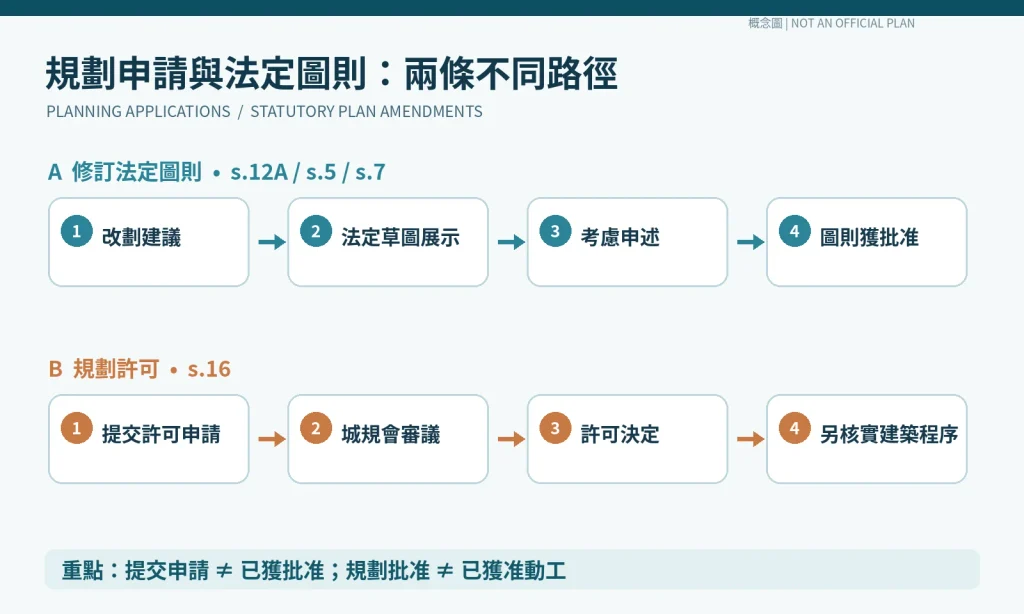
- Section 12A: Application to amend a plan. An applicant asks the Town Planning Board (TPB) to change provisions in a statutory plan, such as a zoning designation or its Notes. A favourable application decision is not, by itself, the completion of every statutory plan-making step.
- Section 16: Application for planning permission. This seeks permission for a use or development requiring the TPB’s approval under the applicable plan. Permission does not automatically rezone the site, and it is not a building-works commencement consent.
- Sections 5 and 7: Statutory exhibition of plans. New draft plans and amendments undergo a formal public exhibition and representation process. Readers need to check the subsequent plan status to know whether a proposal has become part of an approved statutory plan.
The terms “rezoning proposal”, “application accepted”, “draft plan exhibited” and “approved statutory plan” describe different stages. They should never be treated as interchangeable.
3. Four Questions Between an Application and Construction
- What was actually proposed? Read the location, application summary, intended land use and supporting material rather than relying on a headline.
- What did the TPB decide? Check for approval, approval with conditions, rejection, deferral or an application still under processing. A scheduled meeting date is not a decision.
- Has the statutory plan changed? Where a zoning amendment is involved, separately verify the exhibited plan and the version that ultimately received statutory approval.
- Can building works commence? Private building projects generally remain subject to separate plan submissions and consent requirements administered by the Buildings Department.
Planning permissions can also contain conditions, time limits or other requirements. Even a positive planning decision should not be presented as a guaranteed completion date.
4. How to Track Changes Around a Hong Kong Property
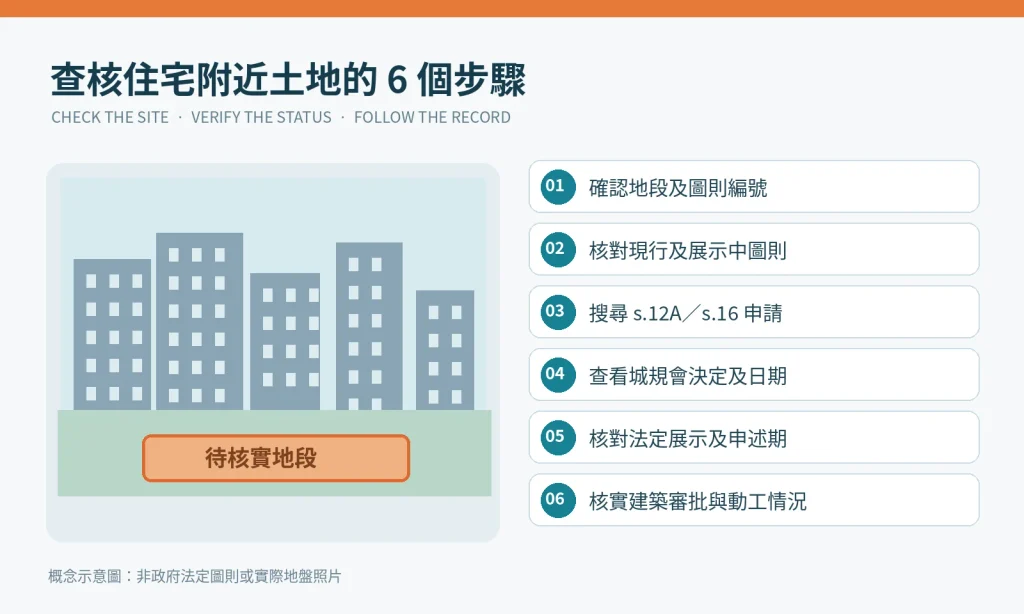
- Step 1 — Identify the correct site. Locate the property and adjacent parcel on the TPB’s Statutory Planning Portal 3 (SPP3). Record the statutory plan number and site boundaries.
- Step 2 — Check the plan status. Consult the TPB schedule of OZPs to compare plan numbers, dates and whether a document is an approved plan or a draft under exhibition.
- Step 3 — Find the application record. Use the applications under processing pages and SPP3 to identify the location, application number, proposed use and related papers.
- Step 4 — Read the decision. Examine the TPB’s decision, conditions, meeting documents and relevant subsequent changes, rather than merely noting that an application was submitted.
- Step 5 — Follow public exhibitions. Review the draft plans under processing and use the official notices to confirm the precise representation period.
- Step 6 — Verify the building stage separately. For private developments, consult the Buildings Department’s new building works guidance and, where relevant, the land lease and other development records.
5. Public Participation: The Type of Procedure Matters
Under the amended planning legislation effective from 1 September 2023, there is no statutory invitation for public comments on Section 12A applications submitted on or after that date. This does not eliminate public participation in the wider plan-making system. New draft plans and plan amendments exhibited under Sections 5 or 7 still have statutory representation procedures. Section 16 applications have separate applicable arrangements for public comments.
Some earlier applications remain subject to transitional rules. Always check the relevant notice and the TPB’s public participation guidance instead of assuming that the same deadline applies to every kind of planning record.
6. Hypothetical Example: A Residential Proposal Across the Road
Imagine a site opposite an estate that is currently zoned for Government, Institution or Community use. A developer proposes rezoning it for residential use, leading to headlines about a possible new housing scheme.
- First confirm that a genuine Section 12A application covers that exact site, and record the application and plan numbers.
- Then check whether it remains under processing, has been rejected or has received a TPB decision. A favourable response still needs to be distinguished from a completed statutory plan amendment.
- Finally, if a development proposal progresses, review its planning conditions and separate building approvals before inferring anything about construction or completion.
This is a fictional teaching example, not a report about an actual Hong Kong site. Its purpose is to illustrate a verification method, not predict future prices, traffic or neighbourhood conditions.
7. Three Principles for Reading Development News
- Separate proposals from decisions. Application documents describe what an applicant wants, not necessarily what has finally been allowed.
- Separate planning from building works. A planning designation or permission alone does not establish that construction is underway.
- Check dates and document versions. A site may have multiple applications and amendments over time; an old record can easily be mistaken for the current position.
Conclusion: Follow the Procedure, Not Just the Map
Proposals to change land use are part of Hong Kong’s ongoing planning process. Reliable interpretation starts with the site and current statutory plan, then distinguishes a Section 12A amendment proposal, a Section 16 permission, the plan-making process and the separate building approval stage.
Public planning records help owners, buyers and tenants understand potential change around a property. They do not, however, guarantee that any individual proposal will be implemented.