
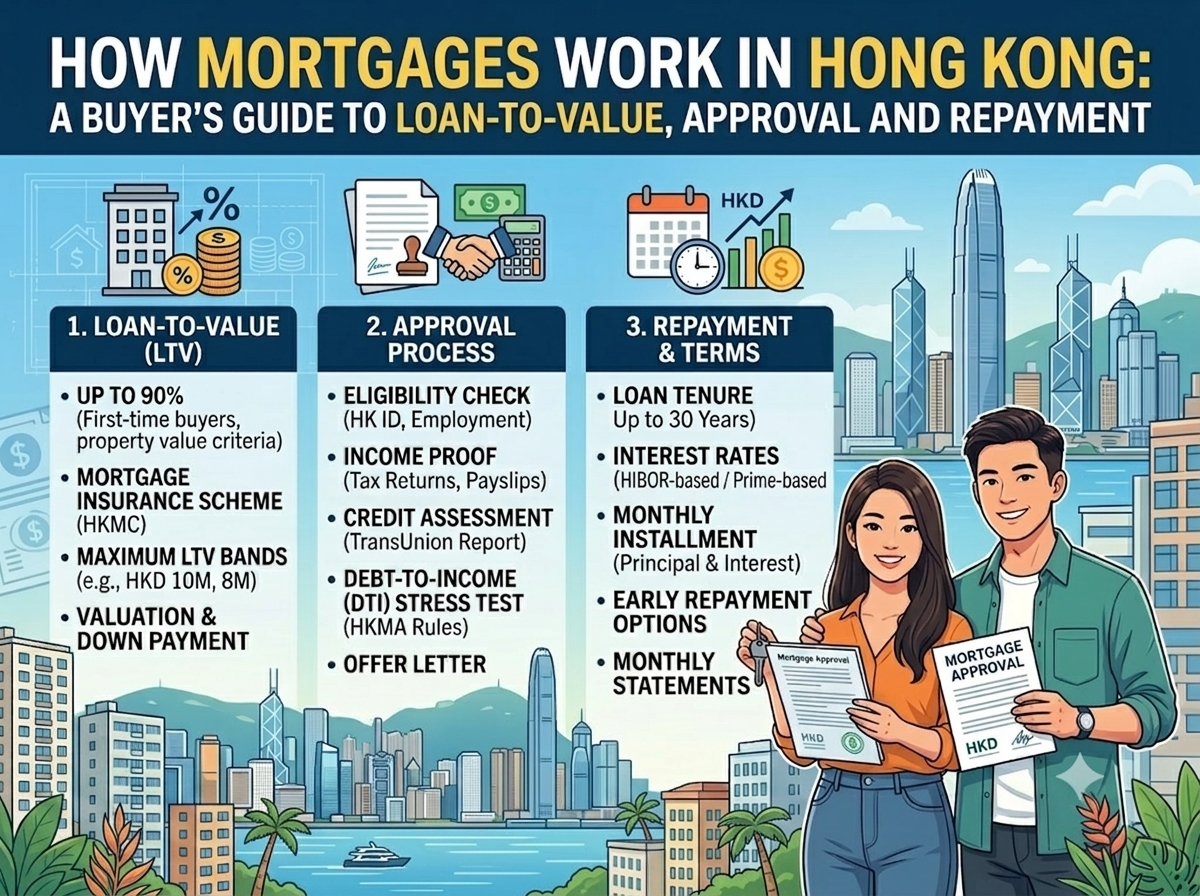
For most buyers in Hong Kong, the mortgage is the single most important part of a property purchase — and often the least understood. The headline price of a flat grabs attention, but it is the loan behind it that decides how much deposit you need, whether your offer is realistic, and what your household budget will look like for years. And there has rarely been a better moment to understand it: in 2024 the authorities relaxed the mortgage rules substantially, and those changes have measurably widened what buyers can borrow.
Consider what shifted. On 16 October 2024 the Hong Kong Monetary Authority standardised the maximum loan-to-value ratio at 70 per cent for all residential properties, regardless of price or whether you intend to live in the flat. Seven months earlier, on 28 February 2024, it suspended the interest-rate stress test that had required borrowers to prove they could withstand a 200-basis-point rate rise. Taken together, these are among the most buyer-friendly settings in over a decade. This guide explains how the system now works — and how to make the most of it.
The building blocks of a Hong Kong mortgage
A mortgage is a long-term loan secured against the property you are buying. If you stop repaying, the lender can recover the outstanding balance by selling the flat. In exchange for that security, banks lend large sums over long periods, typically up to thirty years.
Three numbers define any mortgage. The first is the loan amount, the portion of the price you cannot cover from savings. The second is the interest rate, which sets the cost of borrowing. The third is the tenor, or repayment period, which spreads that borrowing across a set number of years. Move one and the others follow: a thirty-year term rather than twenty-five lowers the monthly payment but raises the total interest paid, while a larger deposit reduces both. The recent rule changes matter because they directly enlarge the first number — how much a bank is allowed to lend you.
Loan-to-value: how the 2024 changes widened your borrowing power
The loan-to-value ratio, or LTV, is the proportion of the property’s value a bank will finance. Until late 2024, caps stepped down as prices rose — higher-value flats attracted lower LTVs, and buyers who already held a mortgage saw their limit cut by a further ten percentage points. The October 2024 reform swept much of that away. The cap is now a flat 70 per cent across the board, the extra ten-percentage-point reduction for holders of other mortgages has been removed, and loans assessed on an applicant’s net worth were lifted from 60 to 70 per cent to match. In practice, an owner buying a second flat, or anyone purchasing a higher-value home, can now borrow considerably more than the rules allowed only a year earlier.
For buyers who cannot fund a large deposit, the Hong Kong Mortgage Corporation’s Mortgage Insurance Programme goes further. First-time buyers who hold no other Hong Kong residential property and draw a regular salary can borrow up to 90 per cent on a flat valued at up to HK$10 million — a deposit of just ten per cent. For homes valued above HK$10 million and up to HK$15 million, financing of up to 80 per cent, or a loan of up to HK$9 million, is available. The programme charges an insurance premium and carries its own eligibility conditions, so weigh the cost, but it brings ownership within reach far sooner than a conventional 70 per cent loan.
One caveat catches many first-time buyers out: banks lend against their own valuation, not the price you agree with the seller. If the bank values the flat below your purchase price, your loan is calculated on the lower figure and you must fund the gap in cash. A preliminary valuation before you sign the provisional agreement is one of the most useful safeguards available.
Affordability: a lighter test, but still a real one
Passing the valuation is only half the battle; you must also prove you can service the loan. The key measure is the debt servicing ratio, which weighs your total monthly loan repayments against your monthly income. Since October 2024 this limit has been standardised at 50 per cent for all properties — up from 40 per cent for non-self-use homes — so a borrower earning HK$60,000 a month can, in principle, commit up to HK$30,000 to loan repayments.
The bigger relief is the suspension of the stress test. Previously, banks checked that you could still afford repayments if rates rose by two percentage points, which effectively shrank the loan many applicants qualified for. With that test lifted since February 2024, the same income now supports a larger mortgage. The trade-off is that the buffer it provided has gone, so it is wise to run your own stress test: confirm you could absorb a rate rise before you borrow to the new limit. Lenders will still require documentary proof of income — payslips, tax demand notes and bank statements — and self-employed buyers should expect closer scrutiny.
The approval journey, step by step
Secure your financing footing before you commit to a flat. Start with a mortgage pre-approval, or approval-in-principle, which indicates how much a bank will lend based on your income and existing commitments. This fixes your realistic budget and signals to sellers that you are a credible buyer.
Once you have found a property and signed the provisional sale and purchase agreement, submit a formal application to your chosen bank, or compare several. The bank arranges its valuation, reviews your income documents and runs the affordability checks. Approaching more than one lender pays off, because valuations, rates and cash rebates differ noticeably; a mortgage broker can do this legwork at no direct cost to you, since brokers are paid by the banks. After the bank issues a letter of offer, your solicitor handles completion, the loan is drawn down, and the funds reach the seller on the completion date. The gap between provisional agreement and completion is often only a few weeks, so any delay in securing the mortgage can put your deposit at risk. Line up your paperwork early.
Choosing a rate structure and repayment plan
Most Hong Kong mortgages are priced on one of two bases. HIBOR-based plans (“H-plans”) track the interbank rate plus a fixed spread, and carry a cap that converts them to a prime-based rate if HIBOR climbs too high — so you enjoy the lower rate when the market is soft but are protected on the way up. Prime-based plans (“P-plans”) are pegged to a bank’s own prime rate and move less often. Neither is automatically better; the right choice depends on the rate environment and your tolerance for month-to-month variation. For context, the HKMA held its base rate at 4.0 per cent in June 2026, and as HIBOR eased from its 2023–24 peaks many borrowers found prime-based plans competitive again — a reminder to compare both at the time you apply rather than assume.
Look closely at the incentives attached, such as cash rebates and interest-offset accounts that let your deposits reduce the interest charged. Check the penalty period too, during which repaying or refinancing early triggers a charge. Because so many Hong Kong owners refinance to chase better terms after two or three years, the length of this lock-in can matter as much as the headline rate.
Common pitfalls worth avoiding
The most frequent mistake is budgeting only for the deposit and forgetting the other cash due on completion: stamp duty, solicitor’s fees, agency commission and any valuation shortfall. Build these in from the outset. A second pitfall is taking on new debt — a car loan or a large credit-card balance — in the months before applying, since every extra repayment eats into your 50 per cent debt servicing headroom and shrinks what the bank will lend. Finally, do not assume the first offer is the best; comparing lenders, or letting a broker do so, can save a meaningful sum over the life of the loan.
The takeaway: the 2024 relaxations — a uniform 70 per cent LTV, up to 90 per cent for first-time buyers, a 50 per cent debt servicing ratio and no stress test — have handed buyers the most generous borrowing framework in years. Use it deliberately: get pre-approved so you know your budget, keep your finances clean before applying, stress-test yourself even though the bank no longer will, and compare offers rather than accepting the first. These figures reflect the rules as of mid-2026; confirm the current limits and rates with your bank or broker before you sign, and you will approach the market with genuine confidence.