
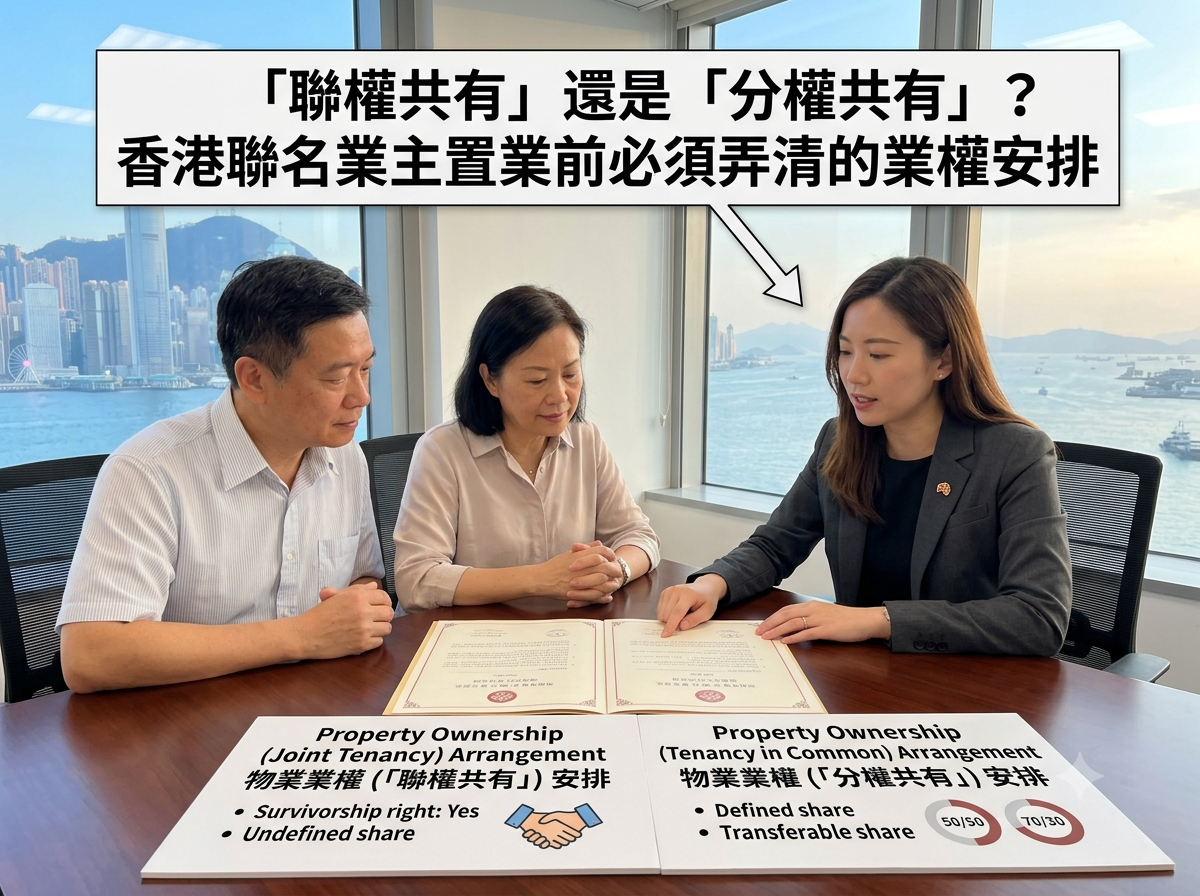
Buying a home with someone else is one of the most common ways people get onto the property ladder in Hong Kong. Couples pool their savings, siblings inherit a flat together, and friends increasingly team up to afford a deposit in one of the world’s most expensive markets. Yet many buyers sign the sale and purchase agreement without settling a question that can matter enormously later: how, exactly, will the two of you hold the property together?
Hong Kong law offers two forms of co-ownership — joint tenancy and tenancy in common. They sound almost interchangeable, and on completion day they feel identical. The difference only surfaces when something changes: a co-owner dies, a relationship breaks down, or one party wants to sell or remortgage. By then the choice is already locked into the assignment, and unwinding it can be costly. Understanding the distinction before you sign is one of the simplest ways to protect yourself and the people you buy with.
The two ways to co-own property in Hong Kong
When two or more people buy a property together, the assignment — the deed that transfers legal title — will state whether they take as “joint tenants” or as “tenants in common”. This is not a throwaway phrase; it defines the legal relationship between the owners for as long as they hold the flat. Your solicitor should ask which you prefer, but the decision is yours, and it deserves a proper conversation rather than a rushed tick-box on the day of signing.
Both forms give every co-owner the right to occupy and use the whole property — neither can claim a particular room or fence off a portion. What differs is what each owner is treated as owning on paper, and what happens to that interest when they die or want out.
Joint tenancy and the right of survivorship
Under a joint tenancy, the co-owners are treated as together owning the whole property, with no distinct shares. Its defining feature is the right of survivorship: when one joint tenant dies, their interest does not pass under their will or under the intestacy rules. Instead it automatically vests in the surviving co-owner or owners, who end up holding the whole flat.
For married couples and long-term partners this is often exactly what they want. If one spouse dies, the other keeps the home without that interest becoming tangled in the estate, and without having to wait for a grant of probate to deal with the share. It is clean, and it keeps a family home in the hands of the survivor.
The flip side is that a joint tenant cannot leave their share to anyone else — not children from a previous marriage, not a sibling, not a chosen beneficiary. Survivorship overrides the will every time. For some households that is precisely the point; for others it is a trap they never realised they had set.
Tenancy in common and defined shares
A tenancy in common works differently. Each co-owner holds a distinct, quantified share, which might be equal — say 50/50 — or unequal, perhaps reflecting who contributed more of the deposit. That share belongs to the owner as an individual asset.
Crucially, there is no right of survivorship. When a tenant in common dies, their share passes under their will, or under the intestacy rules if they left no will, and becomes part of their estate to be distributed like any other asset. This makes tenancy in common the natural choice where owners want to control who inherits their portion — unmarried co-buyers, friends, business partners, or parents protecting children from an earlier relationship.
Unequal shares also make tenancy in common the honest option when contributions are unequal. If you provide the larger part of the purchase price, holding as tenants in common in matching shares records that reality on the title, rather than leaving it to be argued over later.
How your choice shapes mortgages, sales and disputes
In practice, most Hong Kong flats bought with a mortgage are bought by two people, and both usually go on the loan as co-borrowers regardless of how they hold title. Lenders take a charge over the whole property, so if repayments stop the bank can enforce against the flat as a whole. The joint tenancy versus tenancy in common distinction does not shield one owner from the other’s default on a shared mortgage.
Selling is where defined shares can help. A tenant in common can in principle transfer their share, though in reality there is little market for a fractional interest in a flat, and co-owners usually sell the whole property together. If co-owners fall out and cannot agree, either can apply to the court for an order for sale under the Partition Ordinance; the court has wide powers to order a sale and divide the proceeds according to the respective shares. Having those shares clearly set out as tenants in common makes dividing the proceeds far more straightforward.
Stamp duty is also worth a thought. Transfers of interests between co-owners, or restructuring how you hold, can trigger stamp duty just like any other property transfer, and the rules on higher rates for buyers who already own residential property can catch people by surprise. Take professional advice before moving interests around.
Switching between the two
Nothing here is permanent. Co-owners who hold as joint tenants can convert to a tenancy in common — a process known as severance — and those who hold as tenants in common can, by agreement, restructure their shares. Severance is commonly done when a couple separates and no longer wishes a share to pass automatically to the other, or when estate-planning needs change. It is usually a relatively straightforward legal step handled by a solicitor, but it must be done properly and registered so that it binds. Do not assume an informal understanding between owners will hold; get it documented.
Which arrangement suits your situation
There is no universally correct answer; the right structure depends on who you are buying with and what you want to happen down the line. Married couples buying a family home they intend the survivor to keep often lean towards joint tenancy for its simplicity and the automatic protection it gives the surviving spouse. Unmarried partners, friends pooling resources, relatives with children to provide for, and anyone contributing unequal amounts usually have stronger reasons to hold as tenants in common with clearly stated shares.
Whatever you choose, put your intentions in writing. Where owners contribute unequally, or want to record how mortgage payments, outgoings and eventual sale proceeds will be shared, a simple co-ownership agreement or declaration of trust drawn up alongside the purchase can prevent painful disputes years later. This is especially valuable for co-buyers who are not married, as they do not have the fallback of matrimonial law if things go wrong.
The takeaway
Decide how you will hold the property before you sign, not after. Joint tenancy offers simplicity and survivorship; tenancy in common offers control and clearly defined shares. Neither is better in the abstract — only better for a particular set of people and intentions. Raise the question early with your solicitor, be honest about contributions and wishes, and treat the choice as the significant financial and legal decision it really is. This article is general information rather than legal advice; speak to a qualified Hong Kong solicitor about your own circumstances.