
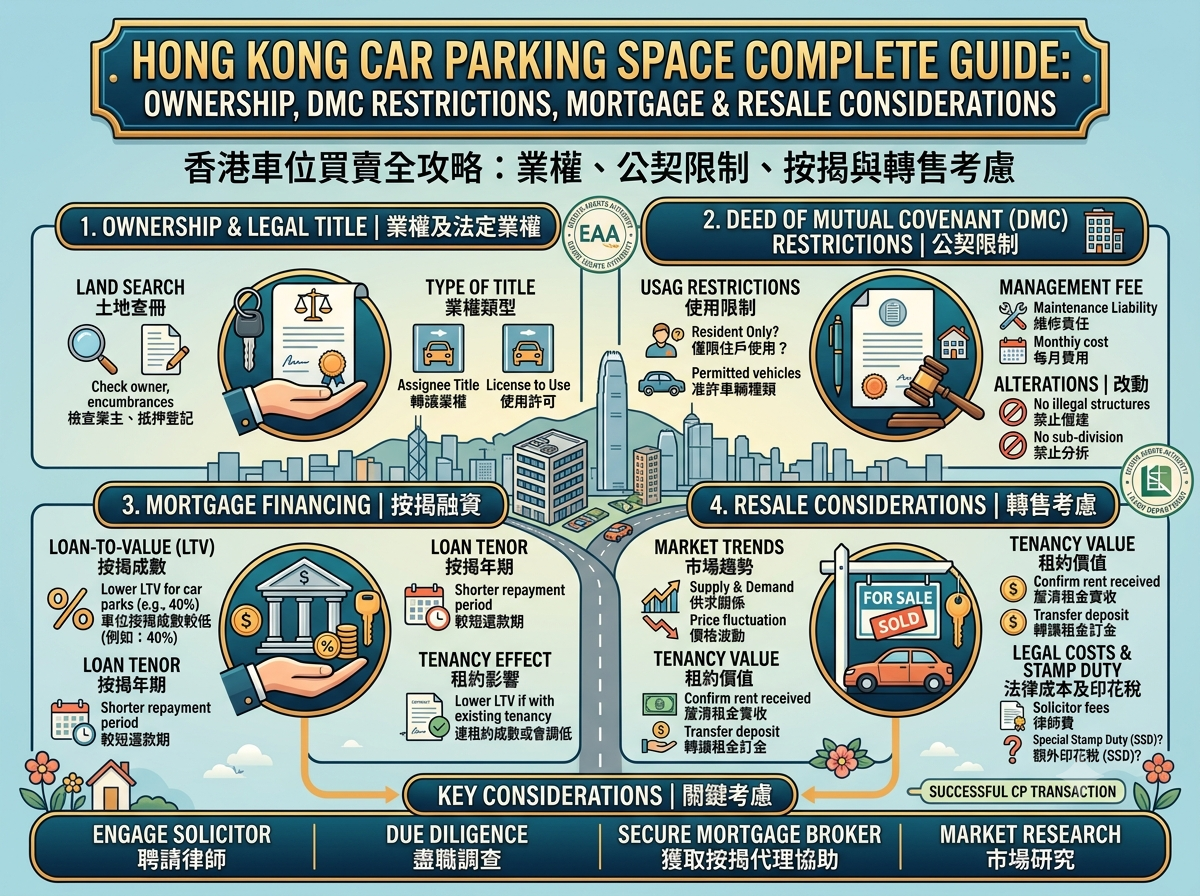
A car parking space looks like the simplest property transaction available in Hong Kong. There is no kitchen to inspect, no view to argue about, no tenant to deal with. It is a rectangle of concrete with a number painted on it. That apparent simplicity is precisely why buyers skip the due diligence they would never skip on a flat — and why car park purchases go wrong in ways that are difficult to unwind afterwards.
The pitfalls are rarely about the space itself. They are about who is legally permitted to own it, what the title actually conveys, and how a bank will treat it. Get those three right and a parking space can be a straightforward asset. Get them wrong and you may own something you cannot let, cannot finance, and cannot easily sell.
A Car Park Is Not a Small Flat
The first thing to establish is what is actually being sold. In most Hong Kong developments, a parking space that can be bought and sold separately is held in much the same way as a flat: the owner holds a number of undivided shares in the whole development, together with the exclusive right to use one identified space, granted through the deed of mutual covenant.
That is the arrangement buyers assume they are getting. It is not the only one in circulation. Some spaces are ancillary to a particular flat and cannot be sold apart from it — the two must move together. Others are not separate property at all but part of the common areas, where what changes hands is a licence or a right to park allocated by the owners’ corporation or the manager, rather than an interest in land. A licence can be revocable, may not be transferable, and is a materially different thing from ownership even though the marketing language often sounds identical.
The distinction shows up in the paperwork rather than on site. A land search against the space, the deed of mutual covenant, and the assignment will tell you which of these you are buying. If a space has no separate undivided shares and no separate title, that is not a detail to be tidied up at completion. It is the whole question.
Who Is Allowed to Own One
This is the restriction that catches the most buyers, and it operates at two levels.
The deed of mutual covenant for many developments limits ownership or use of parking spaces to owners or residents of that development. Where such a clause exists, an outside investor simply cannot buy, however willing the seller is and however the listing is worded. Some estates go further and tie a space to a specific flat, or cap the number of spaces one owner may hold.
Above that sits the government lease or land grant. Many developments were granted on conditions requiring that parking spaces be provided for the use of the residents and occupiers of that development. Where those conditions apply, letting a space to an outsider, or holding it purely as an investment detached from any flat in the development, can put the owner in breach of the lease. This is not a theoretical risk that lives only in textbooks; enforcement action over parking use has been a live issue in Hong Kong, and the consequences attach to the property.
Neither restriction is visible from the space itself, and neither is reliably disclosed by an enthusiastic agent. Both need to be read from the documents by a solicitor before any deposit changes hands.
Why the Financing Is Different
A parking space is non-residential property, and banks treat it accordingly. Expect a lower loan-to-value ratio than you would obtain on a flat, a shorter repayment term, and pricing that reflects the lender’s view of a thinner and more volatile market. Mortgage insurance of the kind available on residential purchases does not fill the gap here.
Some lenders will not finance a standalone parking space at all, particularly where the buyer does not own a flat in the same development, and some set minimum loan sizes that a modest space will not reach. Where a buyer already holds a mortgage on a flat in the development, a lender may be more accommodating, but that is a commercial judgement rather than an entitlement.
The practical consequence is that car park purchases are far more cash-intensive than the headline price suggests. Anyone assuming they can gear a space the way they would gear a flat should have that conversation with a bank before signing a provisional agreement, not after.
Stamp Duty, Rates and the Non-Residential Distinction
Because a parking space is non-residential property, it is assessed for stamp duty under the scale that applies to non-residential transactions rather than the residential one. The various demand-side measures that have applied to residential property over the years have generally been aimed at flats rather than car parks, which is part of why parking attracted investor attention during periods when residential purchases carried heavier duty.
That said, stamp duty policy in Hong Kong has been adjusted repeatedly, and the treatment of any particular transaction depends on the rules in force on the day it is executed. Confirm the current position with a solicitor rather than relying on what was true in an earlier cycle, or on what a seller believes was true when they bought.
Ongoing costs are modest but real. A separately assessed space attracts rates, and government rent may be payable depending on the lease. Management fees are charged on the space in its own right. None of these are large individually, but they run whether or not the space is generating income.
Letting, Yield and Liquidity
Parking is often presented as a high-yield alternative to residential property, and gross yields can indeed compare favourably. The comparison flatters car parks in two respects that matter.
The first is liquidity. The pool of buyers for a space is narrow by construction — frequently limited to owners within a single development — so exit can be slow, and pricing is set by a handful of transactions rather than a deep market. The second is volatility. Car park values respond sharply to changes in supply within the same development, to the arrival of new parking nearby, and to shifts in stamp duty policy that redirect investor attention. A small market moves further in both directions than a large one.
Letting income is taxable and should be declared in the ordinary way. Where the deed of mutual covenant or the government lease restricts use to residents, the pool of permitted tenants narrows accordingly, which is a constraint on income as much as on ownership.
What to Check Before You Commit
Start with a land search against the space itself, not merely the development. It will show whether the space has its own undivided shares and separate title, and whether anything is registered against it.
Then read the deed of mutual covenant for restrictions on ownership, use and letting, and have the government lease conditions checked for a residents-only requirement. Establish whether the space is a designated numbered bay or a floating right, and confirm the space number in the agreement matches the one on the ground — mismatches between the assignment and the painted number do occur and are tedious to resolve.
Inspect the space physically, which buyers surprisingly often skip. Dimensions, pillar positions, headroom and the turning circle on the approach determine whether a particular vehicle actually fits, and a space that suits a compact car may be unusable for a larger one. Headroom matters especially on ramps and in older buildings.
If electric vehicle charging is part of the plan, treat it as a separate enquiry rather than an assumption. Installing a charger typically requires the consent of the owners’ corporation or manager, depends on the building’s electrical capacity, and may be governed by the deed of mutual covenant. Establish what is permitted and what infrastructure exists before paying a premium for a space on the basis that a charger can be added later.
The Takeaway
A car park space is a small transaction that carries a full-sized set of legal questions. The three that decide everything are what the title actually is, who the documents permit to own and use the space, and what a bank will lend against it. All three are answerable in advance from the land search, the deed of mutual covenant, the government lease and a conversation with a lender.
Buyers who work through those questions before signing tend to find parking a perfectly sound asset. Those who treat it as too small to warrant proper legal advice are the ones who discover, months later, that the rectangle of concrete came with conditions attached.