
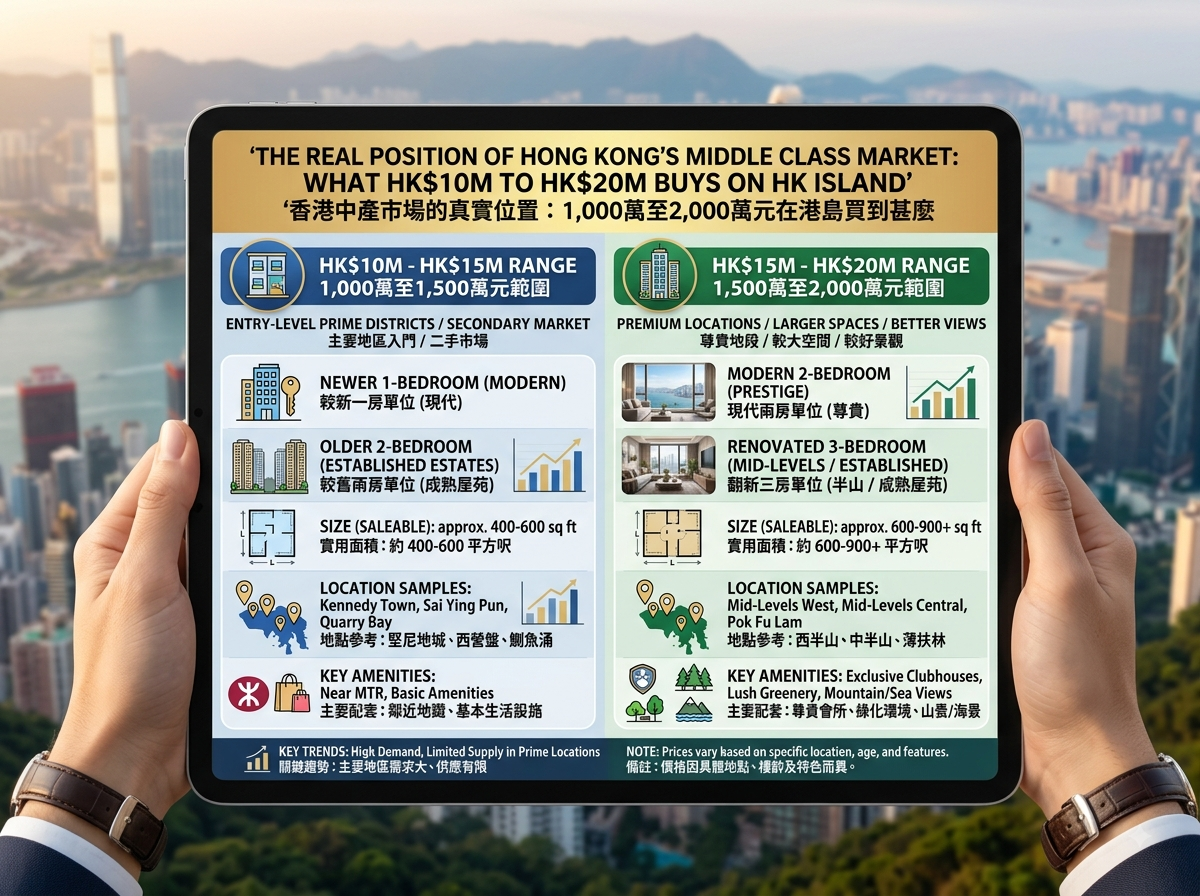
Hong Kong’s property conversation tends to happen at the extremes. Headlines follow the record-breaking house on The Peak or the cheapest flat in the New Territories, and both are interesting precisely because they are unrepresentative. The market a great many established households actually operate in sits between them — the band a professional couple with equity in a first flat, or a family needing a third bedroom, is realistically shopping in. On Hong Kong Island that band runs from roughly HK$10 million to HK$20 million.
It is a wide range in absolute terms and a surprisingly narrow one in what it buys. This piece uses registered transaction data to set out what the middle of the Hong Kong Island market actually looks like: where the deals are happening, what size and age of flat the money reaches, how much a square foot costs across different vintages, and why two buyers in the same band and the same week can post opposite results.
The shape of the band
Filtering registered transaction records for Hong Kong Island and a price range of HK$10 million to HK$20 million returns 6,727 registered sales over the past three years, as at 12 August 2026. The composition of those sales is more instructive than any single deal.
Three districts dominate. Wong Chuk Hang accounts for about 32 per cent of the transactions in the band, Mid-Levels West for roughly 19 per cent and North Point for about 10 per cent — which is to say that a third of all activity at this level is concentrated in one redeveloped district on the south side of the island. By layout, two-bedroom flats make up around 32 per cent of the band; one-bedroom units are just under 3 per cent and studios are statistically absent at 0.06 per cent. By size, about 44 per cent of sales fall between 400 and 800 sq ft and a further 29 per cent between 800 and 1,200 sq ft.
The age profile is the figure worth sitting with. Roughly 32 per cent of transactions in this band are in buildings under five years old, while about 22 per cent are in buildings over forty years old and another 22 per cent in stock aged twenty-five to forty. The same money is buying two very different things, and the market splits almost evenly between them.
One district, two buildings, HK$6 million apart
A pair of North Point transactions registered on 7 August 2026 shows what that split costs in practice. At Fleur Pavilia (柏蔚山), a low-floor three-bedroom flat of 908 sq ft changed hands at HK$20.00 million, or HK$22,026 per square foot of saleable area. At City Garden (城市花園), a mid-floor three-bedroom flat of 945 sq ft sold for HK$13.88 million, or HK$14,688 per square foot.
Same district. Same layout. The older estate’s flat is 37 sq ft larger and cost HK$6.12 million less. The entire difference is roughly 50 per cent more per square foot for the newer building — for the finishes, the facilities, the management and the fact that it was completed this decade rather than in the 1980s.
Neither is the wrong answer. A buyer who values a modern clubhouse, a newer lift core and lower near-term maintenance risk is buying something real. But a buyer who has not made the comparison explicitly may not realise they are paying a half-again premium per square foot for it, and that the same budget stretched to a materially larger flat one street away.
The new-build premium at the top of the range
Wong Chuk Hang shows the same logic at its sharpest, which is much of why it dominates the band by volume. At The Southside (港島南岸), a 499 sq ft two-bedroom flat in phase 4B registered at HK$13.75 million on 7 August, working out at HK$27,545 per square foot. Three days later a 304 sq ft one-bedroom unit in phase 6A registered at HK$10.21 million — HK$33,599 per square foot.
Set those against the City Garden figure and the trade-off is stark. At HK$14,688 per square foot, HK$13.88 million buys 945 sq ft and three bedrooms. At HK$27,545, HK$13.75 million buys 499 sq ft and two. Practically the same money, and practically half the space. A household that genuinely needs the third bedroom is not choosing between these two flats at all — the choice was made for them by the per-square-foot rate long before they walked into either showflat.
Same band, same week, opposite outcomes
The most sobering data in this band concerns what has happened to owners, not buyers. Two transactions registered on 10 August 2026 illustrate the spread. At Residence Bel-Air (貝沙灣) in Pokfulam, a 733 sq ft two-bedroom flat sold for HK$18.00 million, HK$24,557 per square foot, representing a decline of about 17 per cent against its previous sale. At a Braemar Hill estate (寶馬山花園) in North Point Mid-Levels, a 920 sq ft three-bedroom flat sold for HK$18.10 million, HK$19,674 per square foot — a gain of about 27 per cent.
Almost identical prices, the same week, and a forty-point swing between them. Nor are these outliers. Across the whole band over three years, roughly 28 per cent of resales registered a gain of more than 100 per cent against the previous transaction, about 21 per cent a gain of 10 to 50 per cent, and around 16 per cent a decline of more than 10 per cent. Long-held stock has done very well; anything bought near the last peak has not.
No buyer can time a market, and the point is not that they should try. The point is that entry price relative to the prevailing market has done far more work in determining outcomes than the choice of district has — and that the question worth agonising over is whether the asking price is defensible against recent comparable transactions, not whether Pokfulam is a better address than North Point.
The primary market is competing for the same buyer
One external feature shapes this band from outside it. Developers have a substantial pipeline being marketed simultaneously, and much of that stock is aimed squarely at the same purchaser — which is precisely why the newest districts sit so high in the transaction share.
Primary-market incentives are real and should be counted, but counted properly. Developer-arranged financing, stamp duty subsidies, early-completion discounts and furniture packages all reduce the effective price, while making direct comparison with a resale flat harder than it looks. A price list is not a transacted price, and a promotional mortgage that is attractive in its first years may reprice afterwards.
The comparison worth making is not new-build versus second-hand in the abstract, but this specific new flat, at its effective price after incentives and on its actual saleable area, against that specific resale flat at its comparable registered price. Very often the new unit is materially smaller at the same money. A busy primary market has one further effect worth knowing: it gives secondary sellers a reason to be flexible, because they are competing for attention against showflats and incentives.
How to use this when you are searching
Convert every asking price into a price per square foot of saleable area before comparing anything, because absolute prices conceal the trade-off you are actually making. Establish the registered range for the specific building and unit type you are considering rather than the district as a whole — within one estate, the spread between a low floor facing a hillside and a high floor with water can exceed the spread between neighbouring districts.
Decide honestly which side of the space-versus-age trade you are on, and let that determine the district shortlist rather than the other way round. If you need 900 sq ft and three bedrooms at HK$14 million, you are shopping in mature stock, and no amount of viewing new developments will change that arithmetic. Finally, check the transaction history of the individual flat, not just the estate. In a band where roughly one resale in six has registered a double-digit decline, what the current owner paid and when tells you a great deal about how much room there is to negotiate.
The takeaway
The HK$10 million to HK$20 million band on Hong Kong Island is not a choice between districts so much as a choice between space and age, and the market divides almost evenly between the two. Recent registered transactions show new stock trading around HK$27,000 to HK$33,600 per square foot against roughly HK$14,700 in a mature North Point estate — a difference that can halve the flat you end up with. Outcomes for owners in this band have varied enormously and have tracked entry price far more closely than address. Work in price per square foot, compare within the building, and read the flat’s own transaction history before you make an offer.
Transaction figures cited above are drawn from publicly available registered transaction records as at 12 August 2026, covering Hong Kong Island sales between HK$10 million and HK$20 million over the preceding three years. Individual transactions are examples, not market averages, and per-square-foot figures are as recorded against each sale.